
Tag: climate action

  • South Asian Floods Wreak Havoc, Urgent Climate Action Imperative

    South Asian Floods Wreak Havoc, Urgent Climate Action Imperative

    Mohammed Rabnawaz Choudhary
    Mohammed Rabnawaz Choudhary

    By Mohammed Rabnawaz Choudhary

    Large-scale destruction due to floods in South Asian countries , immediate measures are needed to deal with climate change, and steps must be taken to establish a global risk index and ensure food security. The burden of climate change must be distributed fairly, not equitably, if global corporations cooperate, enormous resources can be made available.

    The priorities for South Asian countries have never been clearer, the global adaptation goal needs to be prioritized both in terms of financing and timelines, South Asian countries need additional funding rather than loans to restore and rebuild its infrastructure. Underscoring the need for new, additional and sustainable sources of climate finance, the current financing gap is too large to sustain the real rehabilitation needs of those on the front lines of climate catastrophe.

    A global climate risk index should be created under United Nations, it is a case of now or never, and the mechanisms outlined in the Paris Agreement should respect even more obligations. millions of people were affected by the devastating floods , more than half of whom were women and children.

    Some countries received seven times the average rainfall and trying it’s best to avoid the devastation caused by the melting glaciers. Due to floods, more than thousands kilometres of roads were destroyed,railway tracks were damaged and hundreds of bridges were destroyed and standing crops were damaged.
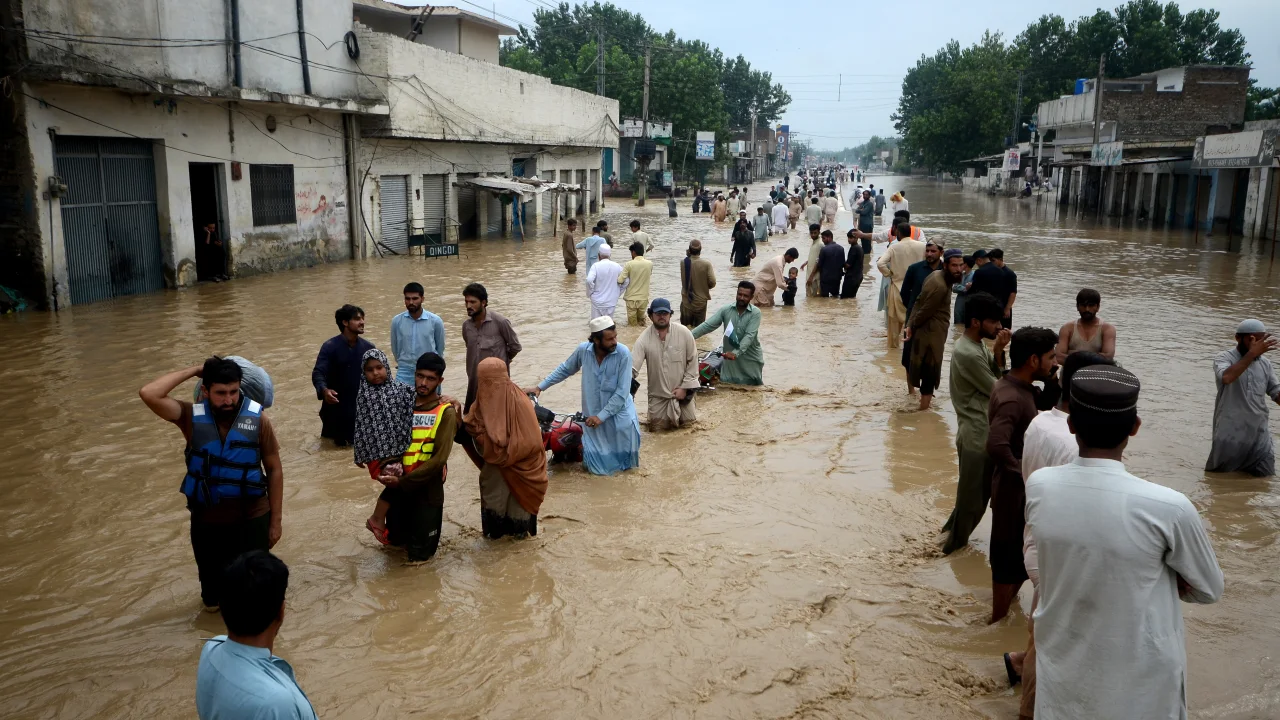
    Displaced people wade through a flooded area in Peshawar, Khyber Pakhtunkhwa, Pakistan on August 28, 2022.
    Displaced people wade through a flooded area in Peshawar, Khyber Pakhtunkhwa, Pakistan on August 28, 2022.

    Billions of US dollars were lost due to floods

    Global adaptation goals need to be prioritized both in terms of financing and timelines. A balance between adaptation and financing commitments, and the current financing gap is too large to sustain the real recovery needs of those on the front lines of climate catastrophe. But funds have to be provided for climate disasters.

    Climate finance should be clearly defined as a new, additional and sustainable resource with a transparent mechanism that meets the needs of developing and vulnerable countries with the speed and scale that is needed.
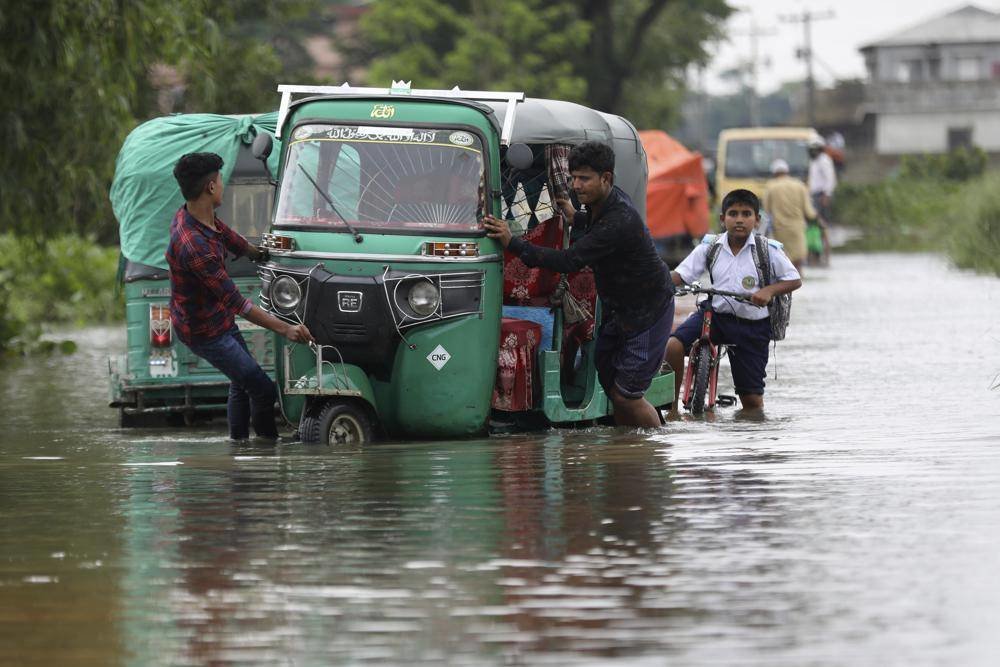
    People push an auto rickshaw through a flooded road as a school boy rides his bicycle behind in Bagha area in Sylhet, Bangladesh, Monday, May 23, 2022. Pre-monsoon deluges have flooded parts of India and Bangladesh, killing at least 24 people in recent weeks and sending 90,000 people into shelters, authorities said Monday. (AP Photo)
    People push an auto rickshaw through a flooded road as a school boy rides his bicycle behind in Bagha area in Sylhet, Bangladesh, Monday, May 23, 2022. Pre-monsoon deluges have flooded parts of India and Bangladesh, killing at least 24 people in recent weeks and sending 90,000 people into shelters, authorities said Monday. (AP Photo)

    In Copenhagen in 2009, at the COP 15, promises were made to provide 100 billion dollars annually till 2020, but they have not been fulfilled yet. A global climate risk index should be created by all parties to the UNFCCC under the UN system. Projects from the most vulnerable countries in this index should receive priority and accelerated approval for climate finance.

    There is a need to restore a clear burden-sharing formula regarding climate change. A commitment to greater obligations than the procedures outlined in the Paris Agreement should be respected. In the winter season, flood victims needed shelter, medical treatment and food, for this countries spent billions.

    All countries in South Asia at highest risk to suffer from such climatic or man-made natural disasters and need additional funds instead of loans to rehabilitate and rebuild infrastructure. Climate change is the biggest crisis of this decade, It is now an undisputed scientific fact that climate change and global warming are happening much faster than we thought, it is also a fact that developing or less developed countries and communities that are on the front lines are in dire need of help.

    A man rides his cycle rickshaw with a passenger through a flooded street after heavy rains in New Delhi. [Anushree Fadnavis/Reuters]  9 Jul 2023
    A man rides his cycle rickshaw with a passenger through a flooded street after heavy rains in New Delhi. [Anushree Fadnavis/Reuters] 9 Jul 2023

    Focusing minds on how the effects of such climate change fall on the most vulnerable, more than half of the millions of people affected by the floods are women and children, of whom thousands of pregnant women were forced to live under the open sky, the livelihood of farmers were destroyed, a million acres of agricultural land had been damaged.Millions of people were in urgent need of health services, humanity has entered a new era of climate change, and the limit of acceptable climate change has already been crossed. Of course, it will not be limited here, as evidenced by the recent effects of climate change in Nigeria and South Sudan.

    The World Bank estimates that if we do not take measures now to deal with climate change, 216 million people will be displaced by 2050, most of whom will be in Africa and South Asia. While 750 million people in South Asia are affected by disasters caused by climate change, 100 million people in developing countries could fall into poverty by 2030. the floods in Pakistan displaced 10 million citizens who became climate refugees in their own country.

    A large number of glaciers and the average rate of snow melting is 3 times. Countries needs climate finance to deal with the impacts of climate change, climate change risk and warning systems and to recover from the devastating effects of climate change. All countries need to urgently solve the problem of the effects of climate change, the burden of climate change should be distributed fairly, not on the basis of equality, it is a matter of climate justice, and we should use this opportunity. Secure the future of the world’s most vulnerable nations.

    Mohammed Rabnawaz Choudhary, a senior Pakistani journalist, holds the position of Vice President at the South Asian Climate Change Journalists Forum (SACCJF).

  • UK, World Bank to support coordinated climate action in South Asia

    UK, World Bank to support coordinated climate action in South Asia

    UK and World Bank are initiating Resilient Asia Program (RAP), investing $63 million over 7 years to accelerate climate action in South Asia.
    UK and World Bank are initiating Resilient Asia Program (RAP), investing $63 million over 7 years to accelerate climate action in South Asia.

    The government of Great Britain and Northern Ireland and the World Bank have launched a partnership—the Resilient Asia Program (RAP) —to accelerate transformational and collaborative climate action to respond to the urgency of climate change challenges in South Asia.

    The UK government has pledged up to $63 million (£50 million) over the next seven years to finance research and analysis, build institutional capacity and expertise to adapt to climate change, strengthen stakeholder and institutional partnerships, and promote greater collaboration for transboundary climate actions and water resource management in South Asia.

    The World Bank will implement the programme, which initially will focus on Bangladesh, Bhutan, India, Maldives, Nepal, and Sri Lanka, but is expected to expand to parts of the wider Indo-Pacific, as per a World Bank press release.

    “Tackling shared global challenges, such as climate change, environmental damage, and biodiversity loss, is a priority for the UK, as stated in our Integrated Review Refresh which defines our overall security, defence, development, and foreign policy,” said Jenny Bates, director general for Asia Pacific, Foreign, Commonwealth & Development Office.

    “The UK’s Resilient Asia Program partnership with the World Bank will develop climate resilience and improve natural resource management, benefitting many millions of people across South Asia and the wider Indo-Pacific.”

    In the first year, the programme will support collaborations to address air pollution, facilitate dialogue and knowledge exchange on thermal comfort and cooling solutions to build resilience to heat, and improve coordination on early warning systems, and weather and climate information among countries in South Asia.

    Effects of climate change increasing in Asia, WMO says
    Effects of climate change increasing in Asia, WMO says

    “More than half of the population in South Asia has been impacted by one or more climate-related disasters in the last two decades,” said Martin Raiser, World Bank vice president for the South Asia Region.

    “The Resilient Asia Program, made possible through the generous contributions of the UK government, is critical and timely to help the countries of South Asia tackle the climate crisis and work together for a resilient future.”

    The RAP is part of the UK government’s overall commitment of up to $348 million (£274 million) to strengthen resilience against the impacts of climate change in the Indo-Pacific region under the Climate Action for a Resilient Asia (CARA) programme.

    Other implementing partners for CARA include the UK’s Met Office, the Asian Development Bank, the United Nations Development Programme (UNDP), and the International Centre for Integrated Mountain Development (ICIMOD).

  • India has shown leadership in climate action: PM Modi

    India has shown leadership in climate action: PM Modi

    Prime Minister Narendra Modi
    Prime Minister Narendra Modi. File Photo.

    New Delhi: Prime Minister Narendra Modi on Saturday said India has shown leadership in climate action, achieved non-fossil installed electric capacity target nine years in advance, and plans to achieve 50% non-fossil installed capacity by 2030.

    Addressing via video link the G20 Energy Ministers’ Meeting, which is currently underway in Goa, he also said that the country plans to achieve the target of 50 per cent of its installed electricity power capacity from non-fossil fuel based energy sources by 2030.

    The PM also stressed the need to have transnational grids and interconnections to enhance energy security.“

    India is making great efforts in green growth and energy transition. India is the most populated nation and fastest-growing large economy. Yet we are moving strongly on our climate commitments,” he said.

    “We achieved our non-fossil installed electricity capacity target nine years in advance. We have set a higher target. We plan to achieve 50 per cent non-fossil electricity by 2030. India is also among the global leaders in solar and wind power,” the prime minister said.

    The world looks up to this G20 group for advanced, sustainable, affordable, inclusive and clean energy transition, he said.

    “While doing this, it is important that our brothers and sisters in the global south are not left behind. We must ensure low-cost finance for developing countries,” he said.

    We must find ways to bridge technology gaps, promote energy security and work on diversifying supply chains, the PM said while calling for strengthening collaboration on fuels for the future.

    The PM said that realising the vision of interconnected green grids can be transforming.

    “It will enable all of us to meet our climate goals, stimulate green investment and create millions of green jobs,” he added.

    Addressing the G20 delegates, Modi said that no talk about the future sustainability of growth and development can be complete without energy.

    Modi said that the country is making efforts for inclusive, resilient, equitable and sustainable energy for all.

    The prime minister invited the delegates to join the green grids initiative – ‘One Sun, One World, One Grid’ – of the international solar alliance.