
By Md Awlad Hossain
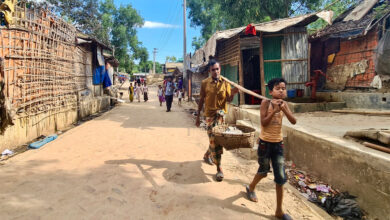
Korail, one of the largest slums in Dhaka, Bangladesh’s capital, is home to around 50,000 people. Just a stone’s throw away from Gulshan, the city’s affluent business district. It is where Salme and Shajahan, along with their families, relocated from the island of Bhola to find work.
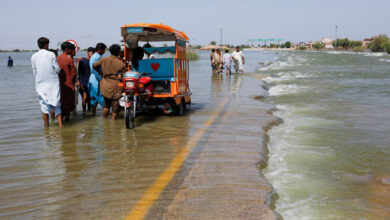
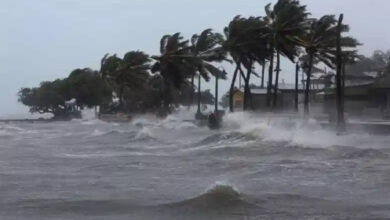
Both emigrated after natural disasters destroyed their homes. Like much of Bangladesh’s coastline, Bhola is regularly battered by cyclones which have become more frequent and intense over the past few decades. Erosion and soil salinisation have wiped out the livelihoods of many people, including theirs.
“I am a widow, and I live with my son in a dilapidated house. But what shall we do? We cannot return to Bhola, our land was washed away,” Salme say summing up her predicament. At least there is work in nearby Gulshan, but their situation remains precarious.
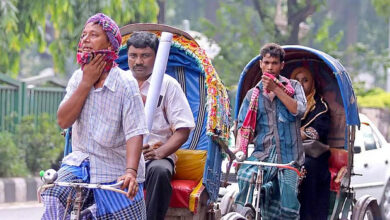
The same applies to Shajahan. “The land my wife and I live on with our seven children technically belongs to the government,” he tells SWI swissinfo.ch. “We are at their mercy. They could evict us at any time.” It wouldn’t be the first time. Both had lived in other slums before they eventually settled in Korail many years ago.
Salme and Shajahan belong to the ever-increasing group of climate migrants. Their relocation from the island to the big city is not unusual, it occurs far less frequently than commonly believed.
Jan Freihardt of the ETH Zurich looked into this very issue in Bangladesh. His findings External linkrevealed that “climate-driven migration is very localised.” Over four years, Freihardt and his team tracked 2,200 people who live along the Jamuna River in the north of the country. The biggest problem, he says, was the erosion of the river.
“During those four years, more than 10% of the people were forced to leave their villages. Most of them moved to neighbouring villages while only few relocated to nearby cities, and even then, only temporarily. Practically nobody moved abroad.” Freihardt was surprised by the clarity of the results.
With more than 170 million people, Bangladesh is one of the most densely populated countries in the world and ranks among the poorest in Asia. Due to its topography, it is also highly vulnerable to the negative effects of climate change which has earned it the label of being a “hotspot”. Apart from cyclones, the country regularly faces increasingly severe droughts and occasional flooding, driven in part by higher rainfall and, in part, by the glacial melt in the Himalayas, which causes the country’s approximately 800 rivers to swell.