Category: Climate Change

  • Heavy rain, strong winds forecast as Bay of Bengal system intensifies

    Heavy rain, strong winds forecast as Bay of Bengal system intensifies

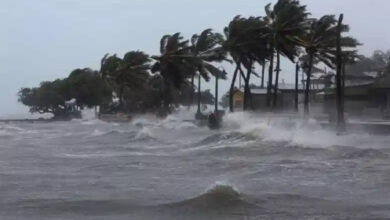
    Colombo, January 6 (Daily Mirror) – A low-pressure area in the Bay of Bengal, located southeast of Sri Lanka, is likely to intensify into a depression within the next 24 hours and move west-northwestwards towards the island’s east coast, the Department of Meteorology said.

    With the development of the system, showery conditions across the country, particularly in the Northern, North-Central, Eastern, Uva and Central provinces are expected to intensify from January 8.

    The Department said showers will occur at times tonight in the Eastern, Central, Uva, North-Central and Northern provinces, with heavy rainfall of around 100 mm likely in parts of Uva province and in the Nuwara Eliya, Matale, Polonnaruwa, Batticaloa and Ampara districts.

    “Tomorrow, showers are forecast at times in Uva province and in Batticaloa, Ampara, Polonnaruwa and Matale districts, with fairly heavy rainfall exceeding 50 mm expected in some areas. Several spells of showers are also likely in the Northern province and in the Anuradhapura and Trincomalee districts, while showers or thundershowers may occur at several other locations after 1.00 p.m,” it said

    In addition, the department said strong winds of up to 50 kmph can be expected at times over the eastern slopes of the central hills, the Northern, North-Central, North-Western and Eastern provinces, as well as in the Hambantota, Gampaha, Colombo and Monaragala districts.

  • Global South 2025: More synergy needed for a green, sustainable tomorrow

    Global South 2025: More synergy needed for a green, sustainable tomorrow

    In 2025, climate change reached a critical stage, particularly in the Global South, said Erik Solheim, former under secretary-general of the United Nations and executive Director of the UN Environment Programme.

    Despite rapid growth in renewable energy, many developing countries face persistent challenges such as inadequate financing, limited technology access and weak adaptive capacity, while geopolitical tensions have further complicated global climate governance.

    Against this backdrop, China has emerged as a key driver of climate action, leading global renewable deployment and clean technology manufacturing. Through new climate targets aligned with the Paris Agreement, governance initiatives and expanded South-South cooperation, China is helping promote a more inclusive and equitable approach to global climate action and sustainable development.

  • South Asian Monsoon in India & Pakistan Emerges as Deadliest Climate Disaster of 2025, Says Report

    South Asian Monsoon in India & Pakistan Emerges as Deadliest Climate Disaster of 2025, Says Report

    The Southwest monsoon season in India and Pakistan in 2025, which saw 8% more rainfall than usual, caused the greatest number of fatalities among the major climate disasters of 2025, according to a report published by Christian Aid. The floods were among the top 10 climate disasters, resulting in over 1,860 deaths and $5.6 billion in losses.

    The report further revealed that heatwaves, wildfires, droughts and storms caused global damage exceeding $120bn in 2025, adding that the 1- most expensive climate-crisis-driven extreme events of the year, each resulting in damage exceeding $1bn. Among them, the Palisades and Eaton wildfires in California alone reportedly accounted for $60bn in losses.

    Asia Bears Heaviest Losses

    The report also said that Asia was home to four of the six costliest disasters, including floods in India and Pakistan that resulted in losses of up to $6bn and affected more than 7mn people in Pakistan alone. Meanwhile, typhoons in the Philippines caused damage exceeding $5bn and forced more than 1.4mn people to flee their homes, it added.

    The disasters caused by cyclones in Thailand, Indonesia, Sri Lanka, Vietnam and Malaysia have been ranked the second most expensive, having caused estimated losses of $25bn. China’s extreme rainfall and flooding from June to August was responsible for losses to the tune of $11.7bn. Category 5 hurricane Melissa that devastated Jamaica, Cuba and the Bahamas in October-end, was the fourth most impactful disaster financially, causing losses worth $8bn, followed by the Indian subcontinent monsoon.

    Hidden Costs, Human Toll

    The report pointed out that most of these estimates are based only on insured losses, meaning the true financial costs are likely to be higher, while the human costs are often uncounted.

    “These disasters are not ‘natural’ — they are the predictable result of continued fossil fuel expansion and political delay,” Emeritus Professor Joanna Haigh at Imperial College London told Christian Aid. “This year has once again shown the stark reality of climate breakdown …The poorest communities are first and worst affected. These climate disasters are a warning of what lies ahead if we do not accelerate the transition away from fossil fuels,” added Patrick Watt, Christian Aid CEO.

  • Climate Justice Is A Moral, Ethical and Legal Issue

    Climate Justice Is A Moral, Ethical and Legal Issue

    By M. S. Siddiqui

    Climate justice is the concept that recognizes climate change as a moral ethical and legal issue, acknowledging that its impacts are felt disproportionately by marginalized and vulnerable populations. It advocates for solutions that address historical inequalities and ensure the burdens, compensation and benefits of climate action are shared fairly, focusing on human rights and equity for all.

    The impacts of climate changes are already damaging ecosystems, livelihoods, infrastructure and food security. Extreme heat exposes workers to heat stress, costing lives and reducing productivity. For example, Bangladesh has been on the front line of climate change for decades, repeatedly confronting heatwaves, tropical cyclones, floods and droughts. Devastating floods are happening more often. Climate change made the pre-monsoon rain that destroyed the summer paddy crop in 2017 twice as likely. Alongside extreme weather, sea level in Bangladesh is rising by 3.8 to 5.8 mm per year – faster than the global average. A recent BIDS study found that during last few years, the income of agricultural workers has been reduced by 20% and global warming may reduce production of rice by 2.5% by 2030.

    Climate impacts in Bangladesh are increasing at an alarming rate, and current safeguards

    Soon there won’t be enough to protect people. The projected sea level rise could displace 0.9 million people by 2050. Bangladesh needs a bolder adaptation response, alongside a functional loss and damage mechanism and a transition away from fossil fuels.

    In 2019, the richest were responsible for more carbon emissions than 5 billion people—the equivalent of 66 percent of humanity, according to Oxfam’s research. To be more specific, it is wealthy polluters—rich industrialized countries and in particular carbon billionaires—that are driving staggering levels of emissions.

    Climate crisis is also causing loss of lives, livelihoods, language, and culture, putting many at risk of food and water shortages, and triggering displacement and conflict. The climate crisis impedes the right to good health as well. Rising temperatures, increased frequency of extreme weather events, polluted air and water contribute to significant health impacts, including heat stress, disease outbreaks, malnutrition, and trauma from having lived through disasters. It has also impacts on a country’s education system and impacts the futures of young generations.

    In between 2010 and 2020, human mortality from floods, droughts, and storms was 15 times higher in highly vulnerable regions, compared to regions with very low vulnerability.

    The impact of climate change has different dimensions based on inequality of structure, socio-economic condition, intergenerational gap etc.

    Structural inequalities occur even within the same country, the impacts of climate change may be felt unevenly due to structural inequalities based on race, ethnicity, gender, and socioeconomic status.

    Socioeconomic inequalities due to climate change due to being distributed unequally around the world. Low-income countries, and vulnerable populations within those countries. Globally, the 10 percent of households with the highest per capita emissions contribute 34–45 percent of global household greenhouse gas emissions, while the bottom 50 percent contribute 13–15 percent.

    Intergenerational inequity among the children and young people today have not contributed to the climate crisis in a significant way but will bear the full force of climate change impacts as they advance through life. Their life and livelihood is impacted by the actions of the previous generations.

    It links human rights to climate change, striving for solutions that are human-centered and protecting the rights of the most vulnerable. It calls for equitable solutions that go beyond emissions reduction to create a more just world, by addressing systemic inequalities and ensuring everyone has access to clean air, water, and food. Some countries and corporations should bear more responsibility for the climate crisis than others, and that solutions must reflect this historical and systemic inequality.

    But it doesn’t affect everyone equally — nor is everyone equally responsible. Climate justice recognizes that unfortunately, those who contribute least to carbon emissions are paying the highest cost. It also hold all responsible – the countries, corporations, and people driving our climate crisis. The climate crisis is affecting every country on every continent. For example, a farmer in Bangladesh emits few greenhouse gases, yet must cope with the extreme weather that devastates her land and livestock year after year.

    Internationally, climate justice is linked with an agenda for human rights and international development, and sharing the benefits and burdens associated with climate stabilization, as well as concerns about the impacts of climate change. In 2022, the UN General Assembly declared that access to a clean, healthy, and sustainable environment is a universal human right.

    The declaration recognizes that the impact of climate change, the unsustainable management and use of natural resources, the pollution of air, land and water, the unsound management of chemicals and waste, and the resulting loss in biodiversity interfere with the effective enjoyment of all human rights.

    The concept of climate justice has been widely used to refer to the unequal historical responsibility that countries and communities bear in relation to the climate crisis. It suggests that the countries, industries, businesses, and people that have become wealthy from emitting large amounts of greenhouse gases have a responsibility to help those affected by climate change, particularly the most vulnerable countries and communities, who often are the ones that have contributed the least to the crisis. Climate justice means putting equity and human rights at the core of decision-making and action on climate change.

    The Principles of Climate Justice have been adopted by a civil society organization (Mary Robinson Foundation) are: (1) Respect and Protect Human Rights, (2) Support the Right to Development, (3) Share Benefits and Burdens Equitably, (4) Ensure that Decisions on Climate Change are Participatory, Transparent and Accountable, (5) Highlight Gender Equality and Equity, (6) Harness the Transformative Power of Education for Climate Stewardship, (7) Use Effective Partnerships to Secure Climate Justice.

    These principles are rooted in the frameworks of international and regional human rights law. However, such laws are often difficult to enforce, particularly when regulatory agencies are underfunded, and issues regarding who has the right to bring a case can make it challenging for communities to raise issues independently.

    Climate justice requires effective action on a global scale which in turn requires a pooling of resources and a sharing of skills across the world. The nation states may remain the basic building block of the international system but without openness to coalitions of states and corporate interests and elements within civil society as well, the risk is that the whole house produced by these blocks will be rendered uninhabitable.

    Openness to partnership is a vital aspect of any coherent approach to climate change, and in the name of climate justice, this must also involve partnership with those most affected by climate change and least able adequately to deal with it – the poor and under-resourced.

    Climate justice places an ethical and moral challenge at the heart of the argument for climate action. It must include legal action based on global commitment of different resolutions and conventions and also refusal to abide by their commitments.

    M. S. Siddiqui is CEO, Bangla
    Chemical. He can be reached
    at shah@banglachemical.com

  • Urban Expansion and Climate Change Threaten Afghanistan’s Cultural Heritage : United Nations

    Urban Expansion and Climate Change Threaten Afghanistan’s Cultural Heritage : United Nations

    The United Nations Human Settlements Programme (UN-Habitat) says that climate change and urban expansion are threatening Afghanistan’s cultural and architectural heritage.

    In a message issued on Saturday, December 13, the UN programme said that preserving historic neighborhoods is essential to safeguarding the identity of cities.

    UN-Habitat has repeatedly warned about unregulated and non-standard urban expansion across Afghanistan.

    The programme also noted that the pace of urbanization in Afghanistan is rapidly increasing.

  • Climate change supercharged deadly $20 billion Asia floods, finds study

    Climate change supercharged deadly $20 billion Asia floods, finds study

    By Joe Wertz and Mary Hui

    Climate change supercharged devastating floods that killed more than 1,600 people across parts of South and Southeast Asia, according to new research.

    A trio of tropical cyclones battered the region from Sri Lanka to Indonesia in November, causing at least $20 billion of losses. The storms resulted in torrential rainfall and destructive floodwaters that swept through homes, businesses and tourist spots, damaged roads and rail lines, obliterated crops and smothered factory output.

    Warmer Indian Ocean waters — about 0.2 degrees Celsius above long-term seasonal averages — likely fueled the two strongest storms, Cyclones Ditwah and Senyar, by supplying extra heat and moisture, scientists reported in a rapid World Weather Attribution analysis released Thursday.

    Without human-driven warming, ocean temperatures would have been roughly 1C cooler, researchers said. They also found that climate change is likely intensifying periods of extreme rainfall such as those seen during the storms.

    The boost from climate change was amplified by seasonal weather cycles and the timing of the storms, which arrived during monsoon season, along with rapid urbanization and widespread deforestation that helped turn torrential rain into catastrophic floods, according to researchers.

    “During the monsoon season, we expect flooding, but up to about one, two [foot] level,” said Lalith Rajapakse at the University of Moratuwa in Sri Lanka. “In some areas, it was exceeding 14 to 15 feet.”

    However, the team was unable to determine exactly how much climate change increased rainfall from the two cyclones. Major climate models produced inconsistent results, likely because they struggle to capture regional dynamics and global patterns such as La Niña, said co-author Mariam Zachariah of Imperial College London.

    Sign up for the Weather Watch newsletter — tracking the market, business and economic impacts of extreme weather with Bloomberg’s team of dedicated reporters.

    Last month’s weather in Asia was “a very extreme event, so we shouldn’t be surprised that climate change models don’t account for it well,” said Matt Sechovsky, head of ESG country research at BMI, a unit of Fitch Solutions. “Climate models tend to have underestimated the pace of climate change that we have seen since around 2022.”

    Many of the same climate models underpin risk models used by insurers and financial firms, which adds economic challenges in a region that is seeing erratic weather more frequently, said Frederic Neumann, chief Asia economist at HSBC Holdings Plc.

    “Although it’s hard to quantify the effect that such uncertainty has itself on growth and livelihoods, it certainly presents a drag on activity, as well as a burden for the region’s populations,” he said.

    Other scientists also found fingerprints of climate change in last month’s floods.

    ClimaMeter, an attribution group at France’s Institut Pierre-Simon Laplace, estimated that meteorological conditions driving Indonesia’s November inundations were up to 7 millimeters a day — or 15% — wetter than they would have been in the past, based on an analysis of historical weather data that don’t rely on climate models.

    The group cautioned that it had low confidence in its findings because similar events are rare and don’t appear routinely in available records. They concluded that natural climate variability, including typically wetter La Niña conditions, likely played little role in the floods.

    The rapid assessment aligns with earlier research that shows “an increasing aggravation of extreme rainfall in Southeast Asia in recent decades,” said Gianmarco Mengaldo, a professor at the National University of Singapore.

  • Cyclone Ditwah to delay Sri Lanka’s fragile recovery, worsen poverty

    Cyclone Ditwah to delay Sri Lanka’s fragile recovery, worsen poverty

    People salvage their belongings from a flooded house along the banks of Kelani River, following Cyclone Ditwah in Peliyagoda, Sri Lanka. Photo: REUTERS/Thilina Kaluthotage
    People salvage their belongings from a flooded house along the banks of Kelani River, following Cyclone Ditwah in Peliyagoda, Sri Lanka. Photo: REUTERS/Thilina Kaluthotage

    Colombo : Sri Lanka’s fragile economic recovery will be delayed as Cyclone Ditwah’s devastation of homes, roads and vital crops pushes more families into poverty, with officials warning the bill to rebuild could soar to $7 billion.

    The worst economic crisis in decades, which peaked in 2022, had already doubled Sri Lanka’s poverty rate to nearly 25% of its 22 million people. A $2.9 billion IMF bailout sparked a tentative rebound, with growth seen at 4.5% this year, but analysts say growth will slow to about 3% in 2026 due to Ditwah.

    Striking in late-November, Ditwah is the country’s deadliest natural disaster since the 2004 tsunami, killing 635 people and affecting about 10% of the population. It wrecked critical infrastructure and key crops such as rice and tea.

    “Cyclone Ditwah struck regions already weakened by years of economic stress,” said Azusa Kubota, United Nations Development Programme (UNDP) Resident Representative in Sri Lanka.

    Recovery is likely to be slower and more costly in regions where high “flooding and high vulnerability overlap”, she added.

    Big rebuilding bill

    The rebuilding bill could hit $7 billion, said Prabath Chandrakeerthi, Sri Lanka’s Commissioner General of Essential Services, urging multilateral partners and donors to step in.

    The government has sought $200 million in emergency funds from the IMF, which is reviewing the request. An IMF team will visit in January for a fresh assessment before releasing the sixth tranche of the original programme.

    New UNDP analysis shows cyclone floodwaters have inundated almost 20% of Sri Lanka’s land area and an estimated 2.3 million people living in flooded areas.

    Sri Lanka cannot shoulder more debt for rebuilding, Kubota warned as she called on international partners for affordable financing to prevent the “country falling off the debt cliff”.

    Analysts say reforms such as restructuring loss-making state firms may be delayed as Colombo prioritises cyclone recovery.

    Damage to tea, rice crops

    Sri Lanka’s $5 billion apparel and $1.5 billion tea industries, together employing more than a million people, are reeling in the wake of the cyclone, with factories reporting low attendance for two weeks, industry officials said.

    “Due to rains, floods and soil erosion, tea output will fall by 3–4 million kilos in December,” said Roshan Rajadurai, spokesperson for the Planters’ Association.

    The country typically produces 20 million kg of tea in December, and 200 million to 250 million kg annually, which is exported to countries such as Iraq, Russia, and Turkey.

    Thousands of paddy farmers had just planted for the main cultivation season when the cyclone struck. The UN estimates 575,000 hectares of paddy have been destroyed, out of about 800,000 hectares nationwide.

    Floods wiped out irrigation canals and filled fields with silt and debris, said K.K.G. Thilakabandara, chairman of Sri Lanka’s largest rice farming association.

    “Farmers don’t have funds to replant,” he said.

    “Authorities must act fast and release funds so crops can be replanted. Otherwise, there is no hope for farmers to recover their crop and finances.”

  • Climate Extremes and Maternal Well-Being: Lessons from Tamil Nadu, South India

    Climate Extremes and Maternal Well-Being: Lessons from Tamil Nadu, South India

    As heatwaves intensify and rainfall patterns shift, the effects of climate change in South Asia are no longer confined to the environment; they’re reshaping lives in deeply personal ways. A new India Development Review article, “In Tamil Nadu, Climate Extremes Are Reshaping Maternal Well-being,” by Mittal Institute Associate Dr. Saravanan Thangarajan explores how these environmental stresses are affecting maternal mental health across India. The research, supported by the Mittal Institute and building upon collaborations from Harvard Medical School and the Harvard T.H. Chan School of Public Health, offers insights into the intersection of climate, health, and gender.

    Dr. Thangarajan, a Visiting Scientist at the Harvard T.H. Chan School of Public Health and Ariadne Labs, Brigham and Women’s Hospital, gave us an introduction to his article and shared some images from his fieldwork in Tamil Nadu.

    In Tamil Nadu, South India long summers, tin-roofed homes radiate heat long after sunset. Inside, mothers balance childcare, work, and exhaustion as temperatures rise beyond the limits of breathable air. These quiet, persistent challenges often remain outside the frame of climate adaptation debates, yet they reveal a critical intersection between environmental stress and caregiving, one that resonates far beyond South Asia.

    This research, conducted across all 38 districts of Tamil Nadu in collaboration with Harvard Medical School and the Harvard T.H. Chan School of Public Health, and supported by the Lakshmi Mittal and Family South Asia Institute and the Harvard Kennedy School, explores how rising heat and air pollution influence maternal mental health. Nearly two-thirds of mothers surveyed experienced mild to moderate depressive symptoms, with the highest burden among caregivers of children with disabilities, where social stigma, economic strain, and environmental exposure coincide. While rooted in India’s context, these patterns mirror a broader global reality in which women and caregivers in resource-constrained settings face disproportionate climate-related stress.

    Amid these pressures, women continue to adapt with remarkable ingenuity, from local coordination networks to culturally rooted cooling practices that protect infants and sustain well-being. These findings emphasize the importance of strengthening low-cost, context-appropriate interventions, training health workers in climate-responsive care, and co-designing adaptation systems that center mothers as agents of resilience. This work contributes to the Mittal Institute’s broader effort to illuminate climate-linked vulnerabilities across South Asia and deepen global understanding of maternal and child well-being as indicators of equity and resilience in a warming world.

  • Bangladesh, Bhutan and Nepal unite for climate justice, regional cooperation at COP30

    Bangladesh, Bhutan and Nepal unite for climate justice, regional cooperation at COP30

    Representatives from Nepal speak at the COP30 conference in Belem, Brazil. Photo: TBS
    Representatives from Nepal speak at the COP30 conference in Belem, Brazil. Photo: TBS

    By Shamsuddin Illius

    Bangladesh, Bhutan, and Nepal at the COP30 climate conference in Belem of Brazil on Tuesday called for urgent global action to safeguard the planet, strengthen regional cooperation, and protect vulnerable communities.

    In a joint statement, on behalf of the three neighbouring countries, Nepal emphasised that the three South Asian nations, bound by shared geography and intertwined vulnerabilities, remained among the most climate-exposed countries in the world despite contributing the least to global emissions.

    “Our three countries were united by shared geography, deep climate vulnerability, and a strong commitment to sustainable development,” Nepal said. “Despite contributing least to global emissions, we continued to demonstrate high climate ambition but with limited capacity to respond.”

    Nepal’s country representative noted that while Bhutan had already graduated from Least Developed Country (LDC) status and Bangladesh and Nepal were in the process of graduation, such progress “did not reduce our climate vulnerability nor the scale of support required to safeguard development gains.”

    The statement described the worsening realities across the region: rapid glacier melt in the Himalayas threatening downstream communities in Bhutan and Nepal, and rising sea levels and saltwater intrusion devastating coastal livelihoods in Bangladesh. “These were interlinked impacts,” the statement read, “with melting glaciers feeding rising seas downstream, turning slow-onset changes into severe climate extremes with cascading consequences.”

    “Science was clear: keeping 1.5°C within reach was a matter of our survival,” Nepal declared. “COP30 had to close the ambition gap in Nationally Determined Contributions (NDCs) in line with the first Global Stocktake and accelerate implementation. Revisiting and enhancing 2035 NDCs to align with the 1.5°C pathway was essential.”

    On climate finance, he urged delegates to operationalise the New Collective Quantified Goal with a clear pathway to mobilise $300 billion annually within the broader $1.3 trillion roadmap agreed in Baku. The joint statement reiterated the call to triple grant-based adaptation finance to at least $120 billion per year by 2030, ensuring simplified and direct access to funds for implementing national adaptation plans.

    “Adaptation was an investment in survival and a foundation for sustainable development,” Nepal stressed. “Belem had to deliver a comprehensive set of indicators under the Global Goal on Adaptation and ensure support was predictable, rapid, and directly accessible.”

    The delegation further welcomed the Belem Implementation Mechanism and the Framework for Resilient and Locally-Driven Development, emphasising that climate justice and equitable finance were central to effective global climate governance.

    Bangladesh youth delegate Sohanur Rahman, executive coordinator of YouthNet Global, praised the joint initiative, saying: “This united voice from Bangladesh, Bhutan, and Nepal sent a powerful message from the most climate-vulnerable frontlines. Our survival depended on global solidarity and stronger regional cooperation. The time for promises was over – COP30 had to deliver real action, real finance, and real accountability.”

    Nepal concluded with a strong appeal: “Belem had to serve as a turning point to reaffirm our shared commitment and uphold the spirit of Mutirao, the Brazilian call for collective action toward a just and sustainable future.”

  • When rivers swallow land: Bangladesh’s endless battle with erosion

    When rivers swallow land: Bangladesh’s endless battle with erosion

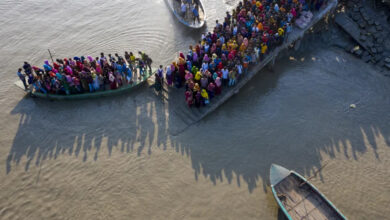
    A drone view shows people carrying the roof of the house belonging to Nurun Nabi, 30, who was forced to relocate to another island due to erosion caused by the Brahmaputra River, in Kurigram, Bangladesh on 29 October, 2025. Photo: Reuters
    A drone view shows people carrying the roof of the house belonging to Nurun Nabi, 30, who was forced to relocate to another island due to erosion caused by the Brahmaputra River, in Kurigram, Bangladesh on 29 October, 2025. Photo: Reuters

    On an overcast morning, Nurun Nabi loads bamboo poles and tin sheets onto a wooden boat. His home, built just a year ago on a fragile island in the Brahmaputra River, is on the verge of being swallowed by water.

    It is the second time the farmer and father of four has had to move in a year.

    “The river is coming closer every day,” Nabi said, his voice tight with exhaustion. “We are born to suffer. Our struggle is never‑ending. I’ve lost count of how many times the river took my home.”

    Nabi, 50, has no choice but to move to another char — a temporary island formed by river sediment. His rice and lentil fields are already gone, claimed by the advancing current of the Brahmaputra, which originates in the Himalayas and flows through China and India before reaching Bangladesh.

    “I don’t know what awaits us there in the new home,” he said, looking towards the wide brown river. “If I’m lucky, maybe a few years. If not, maybe a month. This is our life.”

    Land that disappears overnight

    Every year, hundreds of families in northern Bangladesh’s Kurigram district face the same fate. As riverbanks collapse, people lose not only their homes but also their land, crops, and livestock. The Brahmaputra, Teesta, and Dharla rivers — once lifelines for millions — have become unpredictable, eroding land faster than ever before.

    The chars — sandy, shifting islands scattered across the country’s northern plains — are among the most fragile places in Bangladesh. Families rebuild again and again, only for the river to take everything they have.

    “The water comes without warning,” said Habibur Rahman, a 70‑year‑old farmer who has lived on several chars. “You go to sleep at night, and by dawn, the riverbank has moved. You wake up homeless. There is no peace in our life.”

    As the world’s eyes turn to Brazil, the host of the UN climate summit from 10 to 21 November, Bangladesh’s struggle offers a sobering message for global leaders. The country is often praised as a model of resilience — building embankments, improving flood forecasting, and pioneering community‑based adaptation. But without stronger international support and climate finance, those efforts will fall short.

    “People here are paying the price for emissions they never made,” said Ainun Nishat, a water resource and climate change specialist. “If COP30 means anything, it must deliver real funding for loss and damage and help vulnerable nations like ours protect lives and land before it’s too late.”

    Climate change made visible

    Scientists say what is happening in Kurigram is climate change made visible, as the melting of the Himalayan glaciers that feed the Brahmaputra and Teesta rivers accelerates.

    “We are seeing rapid glacial melt, almost double the rate of the 1990s. Extra water is flowing downstream, adding to already swollen rivers,” said Nishat, the climate change specialist.

    At the same time, the monsoon has grown more erratic — arriving earlier, lasting longer, and falling in intense, sudden bursts. “The rhythm of the seasons has changed,” Nishat said. “When it rains, it rains too much, and when it stops, there are often droughts. This instability is making erosion and floods far worse.”

    He added that Bangladesh contributes less than half a percent of global carbon emissions, yet suffers some of the most serious consequences of climate change.

    The World Bank estimates one in every seven Bangladeshis could be displaced by climate‑related disasters by 2050.

    For Kosim Uddin, 50, a father of seven, moving has become routine. “In my life, the river has taken my home 30 or 35 times — maybe more,” he said.

    “Every time we rebuild, the river comes again,” Uddin said, his eyes fixed on the water. “But where can we go? The whole world is water now.”

    Women carry much of the burden of constant displacement. Shahina Begum, 30, a mother of two, recalled standing in waist‑deep water as she cooked for her family during floods last year. “We moved six times in 10 years,” she said. “Every time we start again, the river takes it back.”

    For Shahina, each move brings new hardships. “It is even more difficult for women and adolescent girls,” she said. “We have to find dry ground, cook, take care of children — and there is no privacy or safety.”

    Building for survival

    On Kheyar Alga Char, about 300 families have managed to stay put for three years after local groups installed geobags — large sand‑filled sacks that strengthen riverbanks against erosion.

    “Geobags have made a huge difference,” said Johurul Islam, 39, who lost his home more than 10 times before settling here. “For the last three years, the river didn’t take our land. For the first time, I feel a little confident about the future.”

    Local NGOs are also helping to build raised villages — clusters of homes elevated above the ground to withstand seasonal floods.

    Standing by the riverbank that has held firm for three years, Islam struck a note of cautious optimism.

    “Maybe the river will come again one day,” he said, smiling faintly. Around him, children played on solid ground, their laughter carried by the evening wind. “This time, we’ll be ready. For now, the land is holding — and so are we.”