Category: Pakistan

  • PTI resisting counter-terror efforts at every forum, seeking help from Afghanistan: ISPR DG

    PTI resisting counter-terror efforts at every forum, seeking help from Afghanistan: ISPR DG

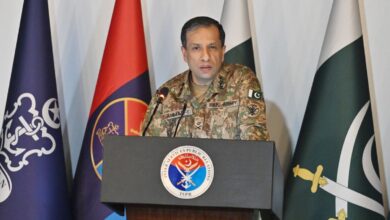
    Islamabad: Inter-Services Public Relations (ISPR) Director-General Lieutenant General Ahmed Sharif Chaudhry came down hard on the Pakistan Tehreek-e-Insaf (PTI) leadership in Khyber Pakhtunkhwa, blaming it for the rising terrorism.

    “The PTI government is seeking help from Afghanistan […] the PTI is also resisting counter-terrorism efforts at every forum,” the military’s spokesperson said during a press briefing in Rawalpindi on Tuesday.

    Lt Gen Chaudhry detailed that nearly 71% of terrorist incidents occurred in 2025 reported from Khyber Pakhtunkhwa and stressed that the primary reason for this is a “politically conducive environment and the flourishing political-criminal-terror-nexus which is flourishing there”.

    An annual report from the Centre for Research and Security Studies also mentions that KP experienced the most significant surge, where the “fatalities rose from 1,620 in 2024 to 2,331 in 2025” — more than 40% year-on-year increase in the province.

    The military’s spokesperson also criticised KP Chief Minister Sohail Afridi’s position on talks and dismissed calls for Afghan security guarantees, while questioning opposition to counterterrorism operations.

    The PTI builds a false narrative while sitting in assemblies, he said, questioning whether the army was sent to KP “with shovels to extract minerals”. Calling KP chief minister’s remarks against operation “ridiculous”, he said that the PTI-backed chief minister’s narrative had “come out clearly”.

    “If you do not want a military operation, then what should be done — sit at the feet of khawarij?” the ISPR DG said. “Should khawarij leader Noor Wali Mehsud be made the province’s chief minister and allegiance pledged to him?” he asked.

    He maintained that seeking assurances from a group accused of harbouring terrorists was illogical, reiterating that counterterrorism required firm state action rather than political ambiguity.

    Referring to governance issues, he said illegal mining was taking place in KP and linked the proliferation of illegal weapons directly to terrorism.

    India-Afghan nexus

    Addressing the hostilities with Afghanistan, the ISPR chief said that the Afghan Taliban regime had attacked Pakistani border posts, following which, “whatever was needed was done, and a hard message was given”.

    “Afghanistan has become the centre of terrorist operations in the region,” he said while explaining the factors behind terrorism. The ISPR chief said that the Afghan Taliban regime has found a “new hero” in the form of Indian Prime Minister Narendra Modi.

    He said that the nexus between Fitna Al-Khawarij and India became fully exposed in 2025, posing a serious threat to regional peace and security. He said that if Afghanistan and India wish to confront Pakistan, they are welcome to do so, adding that, “We will fulfill their desire.”

    Reiterating the resolve to curb the menace of terrorism, he said: “We have to win the war against terrorism at all costs”. “We have to win this war with strength.” “In the last three months, we have closed the borders. There are many signs here for those who see and understand.”

    Noting that Islamabad targeted terrorists at the Afghan border in October 2025, and “dozens of Afghan posts were eliminated within hours”. “We targeted the TTP, not TTA,” said Lt Gen Chaudhry.

    Recalling the Doha agreement, the 2020 US-Taliban peace deal, he recalled that the Afghan Taliban had assured that terrorism would be eradicated from the Afghan soil. However, he lamented, the neighbouring country remains a stronghold of Fitna al-Khawarij and Fitna al-Hindustan.

    All terrorist organisations are based in Afghanistan, and are being nurtured there, he said. Lt Gen Chaudhry said a false narrative is being propagated that the Pakistan Army uses drones during anti-terror operations.

    He said that it was Fitna Al-Khawarij, TTP, which started using armed quadcopters, adding that their patron, India, provides them with full support.

    The ISPR chief said a special wing of the militants operates armed quadcopters, which are used for terrorist activities. He said that terrorists use mosques, public places, and residential homes to carry out attacks and use women and children as human shields to conduct their activities.

    Lt Gen Chaudhry clarified that the Pakistan Army uses drones primarily for surveillance purposes.

    Counterterrorism efforts in 2025

    Providing details of counterterrorism efforts in 2025, the ISPR chief said that law enforcement agencies carried out 75,175 intelligence-based operations (IBOs) across the country.

    Giving a breakdown, he said 14,658 IBOs were conducted in Khyber Pakhtunkhwa, 58,778 in Balochistan, while 1,739 operations took place in the rest of the country.

    Lt Gen Chaudhry said that 5,397 terrorism incidents were reported nationwide during the last year. Of these, 3,811 incidents, he said, occurred in Khyber Pakhtunkhwa, 1,557 in Balochistan, and 29 incidents were reported in other parts of the country.

    He said that 2,597 terrorists were killed during counterterror operations last year. While providing details of 10 major terror attacks across the country, he said that civilians and soft targets had been deliberately targeted, and Afghan militants were involved in all attacks.

    “We have evidence of the presence of all terrorists […] where they are and where they operate,” he said. During the press briefing, video confessions of arrested terrorists were also played.

    Lt Gen Chaudhry said 21 civilians were martyred in the Jaffar Express attack, adding that the incident would never fade from the memory of Pakistanis. He further stated that a civilian bus was also targeted in Noshki, while an attack on the Frontier Corps headquarters in Quetta resulted in the martyrdom of eight civilians.

    “The attack on the FC headquarters in Quetta was carried out by Afghans,” the ISPR DG said, adding that a similar attack had taken place on the FC headquarters in Peshawar in November.

    Referring to an attempted attack on Cadet College Wana in November, the ISPR DG said Afghan terrorists had tried to replicate the 2014 APS Peshawar attack.

    “This is a war of the nation, a war of every single child,” he said, rejecting a narrative portraying the fight against terrorism as solely the military’s responsibility. “A narrative is built, suggesting this is the army’s war. This is not true,” Lt Gen Chaudhry added.

    ‘No distinctions among terrorists’

    The military’s spokesperson stressed that Pakistan’s fight against terrorism was a collective national war, warning that militancy thrived through illegal arms and drugs.

    Referring to Afghan refugee settlements in Pakistan, he said that camps in Punjab and Balochistan had been cleared, while the majority of the camps in KP were still present.

    On the strategy to counter terrorism, Lt Gen Chaudhry reiterated that Pakistan made no distinctions among terrorists, declaring the fight against militancy a national integrity war in which the state and truth would ultimately prevail.

    “There is no colour or shade of a terrorist for us, and we have no sympathy for any terrorist,” he said, adding that the armed forces took pride in the war against terrorism.

    The ISPR DG described Pakistan’s counterterrorism campaign as unparalleled anywhere in the world. “We are on the side of truth, and truth has always prevailed.”

    The army’s spokesperson said that Pakistan had repeatedly engaged the Afghan Taliban regime between 2021 and 2025, saying Islamabad always wanted Kabul to thrive in peace.

    Regarding the closure of the Pakistan-Afghanistan border, he stated that Islamabad was already reaping benefits from shutting down the crossings, adding that Pakistan’s economy was not dependent on Afghanistan.

    The spokesman reiterated that no individual or political party was above Pakistan, saying all political parties and provinces were equal for the military if they stood within the constitutional framework.

    ‘Social media being used for terrorism’

    The military’s spokesperson warned that social media was increasingly being misused for terrorism and criminal activity, stressing that enforcement of laws was essential to protect society and its citizens.

    “Social media is being used for terrorism and for its promotion as well. Laws are meant to ensure the protection of society,” the ISPR DG said.

    The DG ISPR stressed no one would want their daughter to be harassed on social media or people to be defrauded through online platforms.

    “Have social media platforms opened offices in Pakistan?” he asked. “Do these platforms understand that Pakistani laws apply to them?”

    He emphasised that it was essential for Pakistan to ensure the full implementation of the Constitution within its geographical borders.

  • Pakistan Speaker meets Prof Yunus, expresses sorrow over Khaleda Zia’s demise

    Pakistan Speaker meets Prof Yunus, expresses sorrow over Khaleda Zia’s demise

    Dhaka : Pakistan’s National Assembly Speaker Sardar Ayaz Sadiq called on Chief Adviser Professor Muhammad Yunus at the State Guest House Jamuna on Wednesday evening and conveyed heartfelt condolences to the brotherly people and government of Bangladesh on the demise of former Prime Minister Begum Khaleda Zia.

    The two leaders recalled her stature as a distinguished political leader whose resilience and contributions to the democratic evolution of Bangladesh are recognised and appreciated across the world.

    They lauded her dedication to public service, which changed the lives of millions of Bangladeshis for good, recalling her vision for peace, progress and connectivity of the region.

    Thanking the speaker for visiting and expressing solidarity with the people of Bangladesh at this juncture, the chief adviser profoundly recalled his meetings with Prime Minister Muhammad Shehbaz Sharif and DPM/FM Ishaq Dar and appreciated their messages of condolences.

    The speaker arrived in Dhaka on Wednesday to offer condolences on the sad demise of Begum Khaleda Zia.

    On arrival, senior officers of the Ministry of Foreign Affairs of Bangladesh and High Commissioner of Pakistan received him.

    Before the funeral prayer, he had a meeting with Tarique Rahman, son of Begum Zia and Acting Chairman of BNP at the Parliament building.

    On behalf of the President Asif Ali Zardari, Prime Minister Muhammad Shehbaz Sharif, Deputy Prime Minister and Foreign Minister Muhammad Ishaq Dar, Field Marshal Syed Asim Munir, Parliament and people of Pakistan, as well as on his own behalf, the Speaker expressed heartfelt condolences and profound sorrow at the passing away of Begum Zia.

    He reaffirmed that people of Pakistan stand with Tarique Rahman, the bereaved family, members and leaders of BNP and brotherly people of Bangladesh in this moment of deep sorrow.

    He also handed over a condolence letter from Prime Minister Muhammad Shehbaz Sharif to Tarique Rahman, who appreciated the sympathy and solidarity expressed by the Government, Parliament and people of Pakistan in this hour of grief.

    The speaker paid tribute to Begum Khaleda Zia noting the special bond she shared with Pakistan and her commitment towards revitalising historical ties, mutual respect and bilateral cooperation between the two nations.

    Both sides recalled the historical affinities between the two countries and noted that her vision may guide future engagements.

    Afterwards, the speaker offered the funeral prayer of Begum Khaleda Zia.

  • ‘Threat to int’l peace’: Pakistan joins OIC, other nations in rejecting Israel’s recognition of Somaliland

    ‘Threat to int’l peace’: Pakistan joins OIC, other nations in rejecting Israel’s recognition of Somaliland

    Islamabad: The Organisation of Islamic Cooperation (OIC) and other countries, in a joint statement issued on Sunday, slammed Israel’s recognition of Somaliland, terming it a threat to international peace and security.

    The joint statement, backed by Pakistan, Saudi Arabia, Turkiye, Iran, Egypt, Qatar and others, highlights the serious repercussions of such an unprecedented measure on peace and security in the Horn of Africa, the Red Sea, and its serious effects on international peace and security as a whole, which also reflects Israel’s full and blatant disregard to international law.

    The joint statement comes against the backdrop of Tel Aviv’s becoming the first country to formally recognise the self-declared Republic of Somaliland as an independent and sovereign state.

    Israeli Prime Minister Benjamin Netanyahu said Israel would seek immediate cooperation with Somaliland in agriculture, health, technology and the economy.

    In a statement, he congratulated Somaliland’s president, Abdirahman Mohamed Abdullahi, praised his leadership and invited him to visit Israel.

    Netanyahu said the declaration was “in the spirit of the Abraham Accords, signed at the initiative of President Trump”.

    Meanwhile, Abdullahi said in a statement that Somaliland would join the Abraham Accords, calling it a step toward regional and global peace.

    However, the Muslim countries’ joint statement today terms Israel’s recognition “a grave violation of the principles of international law and the United Nations Charter, which explicitly stipulates the imperative of protecting the sovereignty of states and their territorial integrity, and reflects Israel’s expansionist”.

    Backing Somalia’s sovereignty, the joint statement unequivocally rejects “any measures that undermine the unity of Somalia, its territorial integrity or its sovereignty over its entire territory”.

    “The recognition of parts of states constitutes a serious precedent and threatens international peace and security, and violates the cardinal principles of international law and the UN Charter,” it read.

    Furthermore, the statement dismisses “any potential link between such measure and any attempts to forcibly expel the Palestinian people out of their land,” which it said is unequivocally rejected in any form as a matter of principle.

    Somalia thanks Pakistan for ‘sustained support’
    Somalia’s Foreign Minister Abdisalam Abdi Ali thanked Pakistan for its position on the independence of the self-declared Somaliland region.

    The Somali foreign minister’s comments came a day after the Foreign Office (FO) denounced Israel’s announcement recognising the independence of the so-called Somaliland.

    The FO had said that Israel’s announcement not only threatened the “peace and stability of Somalia, but also that of the entire region”.

    Islamabad urged the international community to reject any such actions and prevent and deter Israel from undermining the ongoing efforts for peace and stability in the region.

    In today’s telephonic conversation with Deputy Prime Minister and Foreign Minister Ishaq Dar, he thanked Islamabad for standing by Somalia and for its continued and sustained support.

    The Somali foreign minister also sought Pakistan’s assistance in raising the country’s concerns at the United Nations Security Council (UNSC).

    DPM Dar reaffirmed Pakistan’s unwavering support for Somalia and condemned any actions aimed at undermining the country’s sovereignty and territorial integrity.

  • China-Pakistan warplane deal with Libyan faction ‘may help expand Beijing’s influence’

    China-Pakistan warplane deal with Libyan faction ‘may help expand Beijing’s influence’

    By Liu Zhen

    Pakistan is selling warplanes it jointly developed with China to the Libyan National Army (LNA), a move analysts said could serve as a gateway for Beijing to expand its influence into North Africa.

    In one of Pakistan’s largest-ever arms deals, 16 of the JF-17 “Thunder” fighters were listed among the over US$4 billion worth of military equipment sold to the force led by Khalifa Hifter, which controls the east of the country.

    The deal included other land, sea and air equipment, such as 12 Super Mushak trainer aircraft for basic pilot training, and would be delivered over 2½ years, Reuters reported.

    The plane has previously been sold to Myanmar, Nigeria and Azerbaijan. While most previous sales have been conducted through Pakistan, the latest Pentagon China military power report named the JF-17 as the bestselling Chinese-designed fixed-wing aircraft on the global market.

    “The deal is a way of expanding China’s geopolitical influence through defence-industrial partnerships,” said Liselotte Odgaard, non-resident senior fellow at Hudson Institute. “It enables China to establish market presence behind the veneer of Pakistani exports.”

    The JF-17 is a fourth-generation single-engine, multi-role aircraft developed jointly by Chengdu Aircraft Corporation and the Pakistan Aeronautical Complex.

    Source : SCMP

  • Germany to take in more than 500 stranded Afghans from Pakistan

    Germany to take in more than 500 stranded Afghans from Pakistan

    BERLIN: The German government said Thursday it would take in 535 Afghans who had been promised refuge in Germany but have been stuck in limbo in Pakistan.

    Interior Minister Alexander Dobrindt told the RND media network Berlin wanted to complete the processing of the cases “in December, as far as possible” to allow them to enter Germany.

    The Afghans were accepted under a refugee scheme set up by the previous German government, but have been stuck in Pakistan since conservative Chancellor Friedrich Merz took office in May and froze the program.

    Those on the scheme either worked with German armed forces in Afghanistan during the war against the Taliban, or were judged to be at particular risk from the Taliban after its return to power in 2021 — for example, rights activists and journalists, as well as their families.

    Pakistan had set a deadline for the end of the year for the Afghans’ cases to be settled, after which they would be deported back to their homeland.

    Dobrindt said that “we are in touch with the Pakistani authorities about this,” adding: “It could be that there are a few cases which we will have to work on in the new year.”

    Last week, the interior ministry said it had informed 650 people on the program they would not be admitted, as the new government deemed it was no longer in Germany’s “interest.”

    The government has offered those still in Pakistan money to give up their claim of settling in Germany, but as of mid-November, only 62 people had taken up the offer.

    Earlier this month, more than 250 organizations in Germany, including Amnesty International, Save the Children and Human Rights Watch, said there were around 1,800 Afghans from the program in limbo in Pakistan, and urged the government to let them in.

  • Imran Khan is in a Pakistan ‘death cell’ and the cricketing world is silent

    Imran Khan is in a Pakistan ‘death cell’ and the cricketing world is silent

    Oliver Brown
    Chief Sports Writer

    For a man who was still his country’s prime minister four years ago, life today in Pakistan could hardly be more desolate for Imran Khan. Languishing in Rawalpindi’s Adiala prison, the 73-year-old cricket icon has, according to information shared with the United Nations, been spending 22 hours a day in solitary confinement, with his cell under constant surveillance. Even minimal family visits are understood to be denied, with his country’s military apparently hell-bent on snuffing out his last vestige of resistance. “It’s psychological torture that they’re employing to try to break him,” says his son, Kasim. “But he’s very, very tough to break.”

    Kasim and Sulaiman, Khan’s two boys with his first wife Jemima Goldsmith, are at their wits’ end in pursuing a solution to a nightmare that has been deepening over 2½ years. This week marks the nadir, with an inflammatory social media post dictated by Khan about Asim Munir, the army’s chief of staff – a man whom he accused of “moral degradation” – offering a pretext to strip him of all rights and dignity. Worse, his legal jeopardy is acute, with his 14-year sentence for corruption, based on what he claims is a politically motivated thirst for vengeance, complicated by the constant addition of fresh charges. The family fears that there is no way out.

    “There are over 200 cases,” Kasim explains. “Each time one case is overturned, two or three are put on him. It’s just a way to delay any resolution.” The prison conditions, Sulaiman indicates, are almost beyond endurance. “He’s in a very small cell, which has been described as a ‘death cell’, because this is where they’ve held people who are on death row. Sometimes the electricity is cut off. Sometimes he won’t be allowed reading materials.”

    “The water that he showers in is not just dirty, but discoloured,” Kasim says. “A dozen prisoners in that jail have died of hepatitis, and all of them were supporters of PTI, his political party.” The prison’s superintendent insists that anybody carrying an infectious disease is isolated from other inmates. But a report by Alice Jill Edwards, the UN’s special rapporteur, paints the bleakest picture, with Khan’s cell described as small, poorly ventilated, lacking in natural light, with extreme temperatures and insect infestations leading to nausea and weight loss.

    How ever did we reach this point? We are talking, after all, about an emblematic figure in Pakistan’s history, one of the most sophisticated all-rounders that cricket has produced and the architect of his nation’s solitary 50-over World Cup triumph in 1992. In that tournament, he famously exhorted his players to “fight like cornered tigers”, even wearing a T-shirt emblazoned with the animal to emphasise his defiance.

    His cultured image as a player was matched by his flamboyance beyond the boundary, with his single status and fondness for London’s Tramp nightclub making him a fixture of Nineties gossip columns. Johnny Gold, the club’s owner, likened his effect on women to that of George Best. “No man,” said the model Marie Helvin, “was as devastating as Imran.”

    Jemima, the then 21-year-old heiress whom he married in 1995, was devoted to him. For all the intense scrutiny on the couple’s cultural differences and 22-year age gap, she said after the marriage: “Without in any way wishing to disparage the culture of the Western world, into which I was born, I am more than willing to forgo the transient pleasures derived from alcohol and nightclubs.” Despite the sadness of their divorce in 2004, her concern for his condition, and for the agony his incarceration has inflicted on their two sons, remains acute. Just this weekend, she has written to Elon Musk to urge him to stop suppressing posts on X about Khan, alleging the company was guilty of “secret throttling”.

    “She’s definitely concerned for us,” says Kasim, the younger brother at 26. “She knows how important he is to us. He’s not an estranged father at all. We grew up with him our entire lives, throughout our childhood. He would come to stay with us in Richmond, every single major holiday and some half-terms. We were constantly with him. It’s very difficult for her to watch her sons going through this.”

    Both he and Sulaiman, three years Kasim’s senior, are hopeful that speaking to The Telegraph will help sharpen the public consciousness of Khan’s plight. At times, their lobbying on his behalf can feel futile. With cricket seldom in such an international spotlight as midway through an Ashes series, what better time could there be to highlight the desperate struggle of one of the sport’s enduring idols against the oppressions of the Pakistani state? And yet you look in vain for an official statement anywhere, even from England or Australia – never mind the Indian-dominated International Cricket Council, in whose hall of fame Khan sits.

    The sons are concerned that raising their voices will only intensify the determination of the government of Pakistan’s prime minister, Shehbaz Sharif, to make an example of him. “It seems like every time we react or do anything, they make things worse,” Kasim laments. “This time, they have an agenda to make it pretty dark.” But equally, there is an acceptance that they cannot stand idly by while the persecution escalates.

    “I hated him being in politics when I was younger,” Sulaiman says. “I was constantly worried, because I would hear stories that his life was in danger. There have been two incidents already where he almost died: in 2013, he fell off a 20-foot platform during a rally in Lahore, and three years ago he was shot. As an adult, I have a different perspective on it now. Selfishly, I would love to be able to see him and for him to be with us here. But I also want him to keep going, because this is what he sees as his mission.”

    It is among the more astonishing facts about Pakistani politics that over the past 50 years, every one of the country’s prime ministers has had to serve time in prison. Typically, these situations are resolved by bargaining: Dr Farzana Shaikh, an associate fellow at Chatham House and author of Making Sense of Pakistan, suggests that the only two outlets open to Khan are exile in London or house arrest in his homeland. I ask his sons if any part of them would be eager, if only to alleviate the torment of the bulletins from prison, for him to accept such a deal.

    “I genuinely think he would be depressed if he came to London,” Kasim says. “It would be gnawing away at him that the country was in a shambles and run by these crooks, and I don’t think he’d be able to lead a happy life. What keeps him going, keeps him alive, is fighting against that.” As for enforced seclusion at his house in Lahore, Sulaiman argues that this, too, is off the table. “He wouldn’t be allowed to operate his party or even to speak about politics. He wouldn’t accept that.”

    Both young men, of course, have their own lives to lead, with Kasim the founder of an online marketing platform and Sulaiman maintaining an association with politics since his time working on the 2016 campaign by his uncle, Zac Goldsmith, to become mayor of London. How, I ask, are they coping with the distress at what is happening to their father 4,000 miles away? “Compartmentalising is really important for me,” Kasim says. “I have my job, I play football, but if I allow myself to get buried in what is going on out there, imagining where it is, it makes it impossible to do anything.”

    In an attempt to engineer a breakthrough, he and Sulaiman travelled earlier this year to Washington to meet Brad Sherman, a Democratic congressman, and Richard Grenell, a special presidential envoy, garnering support for Khan’s release. But the notion of President Trump enabling that possibility is, Sulaiman says, remote. “The army chief and Trump have, unfortunately, got quite a good relationship at the moment. Pakistan’s government has said that it will nominate Trump for the Nobel Peace Prize.”

    This leaves only one option for the brothers: to travel to Pakistan themselves, appealing to the better nature of politicians who would rather see their father dragged through indefinite legal turmoil. But the risks are huge, with any action that could be interpreted as a protest leaving them open to arrest themselves. “If we get arrested, it could mean that he loses his leverage, his unbreakable will,” Kasim says. “It might be the one thing that leads him to take a deal, because he never wanted us to be in politics, or to be muddled in his chaos. He would be conflicted, and I’d hate to be the reason for that.”

    There is an even more urgent factor to consider. “I’d just love for us just to visit. He’s 73. It’s hard to know whether we’re even going to see him again.” Amid a benighted chapter in one of the richest sporting lives, this is, surely, the most sorrowful thought of all.

  • Pakistan Army focused on countering internal, external threats: CDF Munir

    Pakistan Army focused on countering internal, external threats: CDF Munir

    Islamabad: Chief of Defence Forces (CDF) and Chief of Army Staff (COAS) Field Marshal Asim Munir has reiterated the military’s preparedness and commitment to deal with all challenges and ensuring national stability, the military’s media wing said on Saturday.

    “Pakistan Army remains fully focused on both internal and external challenges, including hostile hybrid campaigns, extremist ideologies, and divisive elements seeking to undermine national stability,” CDF Field Marshal Munir was quoted as saying by the Inter-Services Public Relations (ISPR) during his visit to the Gujranwala and Sialkot Garrisons.

    It said the CDF was briefed on the formation’s operational readiness and key initiatives aimed at strengthening combat preparedness at the Gujranwala and Sialkot Garrisons.

    During the visit, Field Marshal Munir witnessed a field training exercise and an advanced simulator training facility, lauding the formation’s high professional standards and overall state of readiness, the ISPR added.

    Emphasising the significance of technological adaptability, the CDF noted that modern warfare demands agility, precision, situational awareness and swift decision-making, ISPR added.

    While interacting with officers and soldiers, CDF and COAS Field Marshal Munir lauded the personnel’s high morale and steadfast commitment to national security, while underscoring the importance of rigorous and mission-oriented training.

    The Ministry of Defence had last week issued an official notification for the appointment of Field Marshal Munir as the CDF.

    The CDF — who was promoted to the rank of Field Marshal earlier this year — will concurrently serve as Chief of Army Staff for five years.

    COAS Munir was elevated to the rank of field marshal — Pakistan’s second and the first in more than six decades — following the country’s resounding victory over India in the May war.

    The establishment of the new military title, i.e., the CDF, follows President Zardari’s assent on November 15 to the Pakistan Army, Air Force, and Navy (Amendment) Bills 2025, after their approval by parliament.

    Under the amended provisions, Article 243, which governs the powers and responsibilities of a Field Marshal, will also apply to any General promoted to the rank.

    Earlier this week, CDF and COAS Munir was presented a guard of honour at newly-established Defence Forces Headquarters (DHQ) in Rawalpindi.

    Field Marshal Munir, on the occasion, warned India of a more “severe response” if it resorts to any aggression against Pakistan in the future.

    Speaking on Pakistan-Afghanistan tensions, the Field Marshal said that a clear message had been given to the Afghan Taliban regime in Kabul.

    Reiterating that Pakistan is a peace-loving country, the CDF warned that no one will be allowed to threaten the country’s sovereignty, territorial integrity, or test its resolve.

    Field Marshal Munir also termed the fundamental change “historic”, saying that it was necessary to further improve multi-domain operations under the unified system of the three forces — the army, the air force and the navy.

  • Is Trump’s $686m F-16 upgrade for Pakistan a message to India?

    Is Trump’s $686m F-16 upgrade for Pakistan a message to India?

    By Sarah Shamim

    The United States has approved the sale of advanced technology and upgrades for Pakistan’s F-16 fighter planes worth approximately $686m.

    The deal was struck amid simmering tensions between Pakistan and its neighbour, India, which engaged in a five-day war following a rebel attack in Indian-administered Kashmir in May this year. The US recently pressured Indian Prime Minister Narendra Modi to buy more weapons from it.

    We take a closer look at the US-Pakistan F-16 upgrade deal and why this is significant now.

    What has the US agreed with Pakistan?

    Praveen Donthi, a senior analyst at the Brussels-based non-governmental organisation (NGO) International Crisis Group, told Al Jazeera that the latest approval is part of a 2022 maintenance deal the US agreed in 2022 to sustain Pakistan’s fleet of F-16s.

    “The F-16 deal remains a key part of the broader US-Pakistan bilateral relationship, which is why there has been continuity from President Biden to President Trump, despite some delays. Both sides emphasise the fleet’s utility in joint counterterrorism operations in the region.”

    The latest US deal is for the sale of technology, which will support and upgrade Pakistan’s existing F-16 fleet. It was confirmed in a report sent to the US Congress by the Defense Security Cooperation Agency (DSCA) on December 4.

    Pakistan is believed to have 70 to 80 working F-16s. Some of these are older, but upgraded, Block 15 models, some are former Jordanian F-16s, and some are newer Block 52+ models.

    The US offering comprises hardware and software updates for enhanced flight operations and aircraft electronic systems; the Advanced Identification Friend or Foe (IFF) system, which allows pilots to identify friendly aircraft from enemy ones; navigation upgrades; spare parts and repairs.

    Alongside $649m-worth of support and upgrades for the F-16s, the US sale also includes major defence equipment (MDE), which are items of significant military equipment on the US munitions list, worth $37m. This includes 92 Link-16 systems.

    The Link-16 is a secure military tactical data link network which allows real-time communication between military aircraft, ships and ground forces. It allows communication through text messages and images.

    Six Mk-82 inert 500-pound (226.8kg) general-purpose bomb bodies are another type of MDE authorised to be sold to Pakistan. These are empty metal casings of an Mk-82 bomb, which are used for training or testing.

    Instead of an explosive such as tritonal – a mixture of trinitrotoluene (TNT) and aluminium powder used in munitions – the casing is filled with a heavy material such as concrete or sand. The Mk-82 is an unguided bomb developed by the US. It can also be used as a warhead for precision-guided munitions.

    What are F-16 fighters?

    The F-16, also called the F-16 Fighting Falcon or the Viper, is a single-engine aircraft used for air-to-air combat and air-to-surface attack by the US and its allies.

    The jets are currently manufactured by US defence and aerospace manufacturer Lockheed Martin, which took over production in 1995. It was originally developed by General Dynamics, a US industrial and technology company.

    The jet was developed towards the end of the war in Vietnam, during which the Soviet Mikoyan-Gurevich (MiG) overwhelmed heavier and slower US fighter planes. It first flew in 1974.

    The F-16 is now one of the world’s most widely used fighters. F-16s are operating in 29 countries, according to the Lockheed Martin website.

    Besides Pakistan, some other countries which have F-16s are Ukraine, Turkiye, Israel, Egypt, Poland, Greece, Taiwan, Chile, Singapore, Belgium, Denmark, the Netherlands and Norway.

    What role did F-16s play in the May conflict between India and Pakistan?

    On April 22, armed attackers killed 26 people in Pahalgam, a popular tourist spot in Indian-administered Kashmir. The attack was claimed by The Resistance Front (TRF), a separatist group designated a terrorist organisation by India and the US, and which New Delhi alleges is linked to Pakistan-based Lashkar-e-Taiba (LeT) – a claim Islamabad denies.

    Following the Pahalgam attack, New Delhi scaled back diplomatic ties with Islamabad and suspended the Indus Waters Treaty, which ensures the appropriate sharing of the Indus River water between India and Pakistan.

    On May 7, India struck nine sites in Pakistan and Pakistan-administered Kashmir with missiles, which Islamabad said killed dozens of civilians. Over the following three days, the countries engaged in a heated aerial war, using drones and missiles to target each other’s military bases.

    During the aerial war, Pakistan deployed 42 “hi-tech aircraft”, including the F-16s, and Chinese-made JF-17s and J-10s, according to Pakistan’s Air Vice Marshal Aurangzeb Ahmed.

    A ceasefire – for which US President Donald Trump took credit – was eventually brokered on May 10.

    Is the US applying pressure to India?
    Yes, for a couple of reasons.

    The US approval for Pakistan’s F-16 upgrade comes as the Trump administration presses India to buy more weapons from it.

    In August, New Delhi put its plans to buy US weapons and aircraft on hold, the Reuters news agency reported, quoting three unnamed Indian officials familiar with the matter.

    This came just weeks before Indian Defence Minister Rajnath Singh had been scheduled to visit Washington to announce some weapon purchases. That visit was cancelled.

    India-US relations have also been tense in recent months.

    On August 6, Trump imposed an additional 25 percent tariff on imports from India as a punishment for buying cheap Russian crude oil. This was on top of the existing 25 percent tariff already levied on Indian goods, bringing the total levy on Indian imports to 50 percent.

    Trump announced the tariff in an executive order, in which he wrote that Russia’s continued military actions in Ukraine constituted a “national emergency” and it was therefore “necessary and appropriate” to place heightened tariffs on India, a top consumer of its crude oil.

    “I find that the Government of India is currently directly or indirectly importing Russian Federation oil.”

    While pressure from the US has resulted in India slightly scaling back purchases of Russian oil, New Delhi plans to continue to buy from Moscow. It remains the second-largest consumer of Russian oil after China.

    President Vladimir Putin met Prime Minister Modi for the annual Russia-India bilateral summit in New Delhi last week, during which he said: “Russia is ready for uninterrupted shipments of fuel to India.”

    The announcement of the latest US deal to provide maintenance and upgrades for Pakistan’s F-16s is likely to be poorly received by India.

    Donthi said New Delhi has previously opposed the defence cooperation between Pakistan and the US under which the two countries collaborate to maintain Pakistan’s F-16 fleet. India has claimed the F-16s are used against it.

    “Washington pre-empted it this time by stating that the sale ‘will not alter the basic military balance in the region’,” Donthi said.

    Michael Kugelman, a South Asia analyst based in Washington, DC, told Al Jazeera: “I wouldn’t overstate the India angle here. Certainly one may look at this deal as the latest attempt by Washington to use its largesse to Pakistan as a pressure point to get India to make more concessions to the US in trade talks.”

    However, he added that the deal is one that “has a logic of its own that’s not tied to India”.

    It is largely a standalone arrangement within a long‑running program to support Pakistan’s US-made aircraft. It comes alongside continued, though less generous, US defence cooperation with India – reflecting two parallel tracks of security ties rather than a single India‑focused strategy, Kugelman explained.

    How much does the US sale strengthen Pakistan?
    Kugelman said the package is significant. “It is one of the more generous security aid packages to Pakistan in recent years. Nearly $700 million is nothing to sneeze at.”

    The deal is also significant for US-Pakistan relations as it signifies the importance the Trump administration places on counterterrorism cooperation with Pakistan.

    “Critical minerals and other commercial opportunities have drawn the most headlines in discussions about the resurgence in US-Pakistan ties. But counterterrorism collaborations, while modest in scope, are important for this administration,” he said.

    However, Donthi pointed out that while the latest package from the US will help Pakistan maintain its fleet until 2040, it is China which has supplied more than 80 per cent of Pakistan’s weapons since 2020.

    This statistic is also backed by Swedish think tank SIPRI in a report this year.

    “Pakistan used Chinese J-10 aircraft in the May conflict with India. Islamabad continues to balance between Washington and Beijing, benefiting from both,” Donthi said.

    Source : Aljazeera

  • Pakistan’s military sentences its former spy chief to 14 years in jail

    Pakistan’s military sentences its former spy chief to 14 years in jail

    Islamabad: Pakistan’s former spy chief has been sentenced to 14 years in prison by a military court, on charges including violation of state secrets and interfering in politics.

    Faiz Hameed led Pakistan’s Inter-Services Intelligence (ISI) agency from 2019 to 2021, during the tenure of now-jailed former prime minister Imran Khan.

    He was known to be a staunch supporter of Khan, and took early retirement shortly after Khan was ousted in a no-confidence vote in 2022.

    It is the first time that an ISI chief in Pakistan has been court martialled.

    The ISI chief is seen as the second most powerful position in Pakistan’s military.

    According to a press release issued by the public relations arm of Pakistani military (ISPR), the 15-month-long court martial proceeding began on August 12, 2024, under the Pakistan Army Act.

    Hameed was tried on four charges, including “involvement in political activities, violation of the Official Secrets Act which harmed the interest of the state, misuse of his powers and government resources, and causing harm to citizens”.

    The ISPR statement added that Hameed had been given “the right to have a defence team of his choice” and that he has the right to appeal the decision in the “appropriate forum”, which would be the Supreme Court of Pakistan.

    The exact details of the case are not public as the hearing was held behind closed doors in a military court.

    The statement says that Hameed’s alleged involvement in fomenting political agitation and instability is being dealt with separately.

    This is assumed to be regarding allegations that Hameed was tied to protests against Imran Khan’s arrest on 9 May 2023.

  • Punjab assembly passes resolution seeking ban on PTI and Imran Khan

    Punjab assembly passes resolution seeking ban on PTI and Imran Khan

    FILE PHOTO: Former Pakistani Prime Minister Imran Khan pauses as he speaks with Reuters during an interview, in Lahore, Pakistan March 17, 2023. REUTERS/Akhtar Soomro/File Photo
    FILE PHOTO: Former Pakistani Prime Minister Imran Khan pauses as he speaks with Reuters during an interview, in Lahore, Pakistan March 17, 2023. REUTERS/Akhtar Soomro/File Photo

    Islamabad : The Punjab Assembly on Wednesday passed a resolution calling for a ban on jailed former prime minister Imran Khan and his Pakistan Tehreek-e-Insaf (PTI) party, as tensions between the governing Pakistan Muslim League-Nawaz (PML-N) and the opposition intensified.

    The resolution, moved by PML-N lawmaker Tahir Pervaiz, was approved by treasury members. PTI legislators boycotted the session after the government blocked meetings with Khan at Rawalpindi’s Adiala Jail, says Dawn.

    The resolution described the PTI and its leader as “anti-state” and said the party had allegedly acted as a “tool of the enemy state” and promoted disorder. It accused Khan of making statements against the country and emphasised the role of state institutions in maintaining national stability. It also called for “appropriate punishment” for any individual or group acting unlawfully.

    Political temperatures rose further after Inter-Services Public Relations (ISPR) Director General Lt Gen Ahmed Sharif Chaudhry criticised Khan — without naming him — for creating and spreading an “anti-army” narrative that he said posed a “national security threat.”

    Punjab Information Minister Azma Bokhari said the government might consider measures such as a ban on the PTI or governor’s rule if the party did not change its approach. She compared Khan to “Altaf Hussain Part Two,” alleging he had pushed Pakistan toward global isolation and used a foreign-based propaganda cell for campaigns against state institutions and the military.

    Sit-in Outside Adiala Jail

    Separately, supporters of Imran Khan gathered outside Adiala Jail after his sisters were again denied a meeting with him, despite a court order permitting family visits on Tuesdays and Thursdays.

    Aleema Khan, who led the sit-in, said keeping her brother isolated and tortured was “unconstitutional and illegal,” adding that “they are violating the Constitution and breaking the law.” She said Khan had not been allowed to meet his personal physician for 14 months. Riot police stopped her and a group of supporters about a kilometre from the prison.

    PTI Chairman Barrister Gohar Ali Khan, present nearby, urged authorities to allow access to the former prime minister, saying that doing so would “improve the situation.” Party leaders said workers were “charged,” particularly after the DG ISPR’s remarks, and prepared for a prolonged sit-in until one of Khan’s sisters was permitted to meet him.

    The developments underscored heightened political frictions, with legislative actions against the PTI coinciding with street protests and disputes over Khan’s access to family and legal counsel.