

Dhaka: The 13th national election and a referendum on proposals made in the July National Charter will be held simultaneously on the same day in the first half of February next year, Chief Adviser (CA) Muhammad Yunus has said.
The Advisory Council of the interim government has also approved the July National Charter (Reform of Constitution) Implementation Order 2025, he said during a national address today (13 November).
Bangladesh Television (BTV), BTV News, and Bangladesh Betar simultaneously aired the chief adviser’s speech from 2:30pm.
He said the government is taking all-out preparations to hold the election in a festive atmosphere, alongside the referendum.
This arrangement would not hinder the goals of reform; rather, it would make the election process more festive and cost-effective, Yunus said.
Necessary legislation will be enacted in due time to facilitate the holding of the referendum, he added.
4 key points of the referendum
Referring to the July Charter, he said the question to be presented on the referendum ballot has already been finalised.
He read the question aloud, “Do you approve the implementation of the July National Charter [Constitutional Reform] Ordinance, 2025, and the following reform proposals recorded in the July National Charter?”
The question will include four key points:
a) During the election period, the caretaker government, the Election Commission, and other constitutional bodies will be formed in accordance with the procedures outlined in the July Charter.
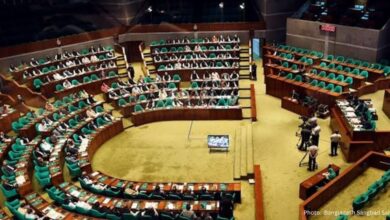
b) The next parliament will be bicameral (two chambers). A 100-member upper house will be formed based on the proportion of votes each party receives in the national election, and any constitutional amendment will require the approval of a majority of upper house members.
c) The political parties have reached a consensus on 30 reform proposals included in the July Charter, covering areas such as increasing women’s representation in parliament, electing the deputy speaker and parliamentary committee chairs from the opposition, limiting the prime minister’s tenure, enhancing the president’s powers, expanding fundamental rights, ensuring judicial independence, and strengthening local government. The winning parties in the upcoming election will be obliged to implement these agreed reforms.
d) Other reforms described in the July Charter will be implemented in line with the commitments made by political parties.
On referendum day, voters will express their opinion by casting a single vote, “Yes” or “No” on all four points combined, Yunus explained.
If the majority votes “Yes,” a Constitutional Reform Council will be formed, composed of representatives elected in the upcoming election. These representatives will serve simultaneously as members of the Parliament, he said.
He further stated that the council will have 180 working days from its first session to complete the constitutional reforms. Once the reforms are finalised, a 100-member upper house will be constituted within 30 working days, based on the proportional vote share of the political parties.
The tenure of the upper house will be until the last working day of the lower house.
According to the pledge to implement the July National Charter, steps will be taken to incorporate the charter into the Constitution. This was also mentioned in today’s approved order.
The CA addressed the nation after an Advisory Council meeting, which he chaired in the morning, finalised the decisions regarding the July Charter, referendum, election, and other important matters.
Political divide
On 28 October, the National Consensus Commission submitted two alternative recommendations to the interim government on how to implement the July Charter.
One proposal suggested issuing a special order to hold a referendum on the charter’s constitutional reform proposals. If the referendum passes, the next parliament would act as a Constitution Reform Council, tasked with completing the reforms within 270 days.
If it fails to do so within that time, the proposed reforms would automatically be incorporated into the constitution.
The second proposal is largely similar, except it only states that the reforms must be completed within 270 days — without specifying what would happen if the deadline is missed.
However, the Consensus Commission left the decision on when the referendum will be held to the interim government.
Political parties have already been divided over how the July Charter and its reform proposals would be implemented, but the submission of the commission’s recommendations has intensified those disagreements.
The BNP had submitted notes of dissent on several points of the July Charter, opposing recommendations for implementation. The party has been demanding that the general election and referendum be held on the same day.
It also rejected forming an upper house under the proportional representation (PR) system.
Jamaat, on the other hand, supported forming an upper house under the PR system and wants the referendum to be held before the national election.
After the last Advisory Council meeting on 3 November, the government had given the political parties seven days to reach a consensus on the issue. However, as the parties failed to do so, the government has now decided on its own.


2 Comments