
South Asia Highly Vulnerable to Survival Crisis, Must Seek Path of Peace and Cooperation

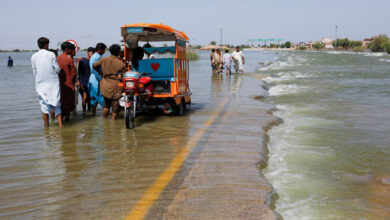
![Men carry children on their shoulders and wade along a flooded road, following rains and floods during the monsoon season in Nowshera, Pakistan [File: Fayaz Aziz/Reuters]](http://southasiancorrespondent.com/wp-content/uploads/2025/10/cm.jpg)
Survival crisis is caused by a number of serious environmental problems and accumulation of highly destructive weapons combining together to threaten basic life-nurturing conditions. While the entire planet is affected by this, some regions are particularly vulnerable. South Asia is one such region.
This is the world’s most densely populated region which has less than 5% of the world’s area and about 25% of the world’s population. The greater part of the region suffered from nearly 200 years of colonial rule. Some of the sprawling areas in big cities like Mumbai, Karachi, Delhi, Kolkata and Dacca are particularly very densely populated, a substantial portion living in slum areas in conditions of high levels of pollution, lack of essential services and potential heat island conditions as well as flooding of low lying areas.
A substantial part of the region consists of mountains, deserts, coastal and flood-prone areas which are highly vulnerable to increasing disasters in times of climate change. The vast Himalayan range comprises the youngest mountains in geological terms, still being formed and highly unstable as well as constituting an area of high seismicity. Their ecology must be protected very carefully to prevent disasters here and in the plains below.
Further spread of deserts must be avoided and natural fertility of land and topsoil must be protected to feed future generations. In conditions of fast declining water table and water scarcity as well as pollution and contamination, water conservation should get very high priority and rivers big and small, ponds and lakes should be well protected. What remains of natural forests and wild life should be well protected from several threats.
All these basic natural resources are under increased threat in times of climate change and the threat of various disasters is increasing. Despite big investments having been made on embankments and dams, the harm caused by floods has been increasing, while several new problems have paradoxically appeared precisely because of such structures. Despite increasing claims of reducing poverty, a very large number of people live frighteningly close to the margins of poverty and disruptions related to climate change, disasters and other adversities can deprive them of the capacity to meet basic needs.
The drift towards increasing inequalities makes it more difficult to find adequate resources for improving the prospects of the bottom one fourth of the population, nearly 500 million people.
With increasing harm being caused to soil health and farm biodiversity and depletion of water sources as well as pushing of harmful technologies and policies by big corporate interests and multinational companies, the capacity of the region to produce adequate and healthy food is being eroded.
Despite increasing glitter at the top, the basic living conditions remain fragile for a large number of people and densely populated regions remain vulnerable to several adverse consequences of many-sided environmental crisis including climate change. Urban and to a lesser extent rural population face increasing health and other problems from increasing air pollution which is proving life-threatening to many people, particularly the elderly but also others including children.
In such conditions, civil strife and international tensions are increasing in South Asia. Several wars have already been fought, particularly involving the two countries which are now nuclear weapon countries. Increasing instability has been seen in some countries, including removal or even jailing of prominent political leaders. Democracy shows a weakening trend.
In these conditions there is increasing pressure for increasing military expenditure and for acquiring more destructive weapons. In particular the patronization of terror groups by Pakistan has increased problems for neighboring areas as well as ultimately inwardly for Pakistan too. The risk of hostilities breaking out has remained high in recent times and in this context the use of nuclear weapons too continues to be mentioned as a possibility, although fortunately still a distant possibility. The hostility based agenda is further worsened by several sectarian groups also trying to promote such hostilities along the lines of inter-faith conflict. This has happened despite South Asia being the abode of some of the biggest promoters of inter-faith harmony and fraternity of all people, true leaders of peace who attracted millions of followers but whose message of peace and love is being drowned in the hostile slogans of recent times.
The reasons for South Asia adopting the path of peace and cooperation have increased further in times of climate change and worsening of other environmental crises. It is only by ensuring peace and cooperation that the basic life-nurturing conditions can be protected and safe and satisfactory life can be ensured to the people. On the other hand nuclear war can bring complete destruction while even an extended war with conventional weapons can prove highly destructive in densely populated regions and cities. Hence wisdom should dawn on the leadership of the region to get together and agree that the path of peace and cooperation is the only path available to prevent massive and increasing distress being caused to the people of this region in these very difficult times when the entire world is confronting nothing less than a survival crisis.
3 Comments