Tag: Mohamed Nasheed

  • Maldives’ Presidential Elections at The Crossroads

    Maldives’ Presidential Elections at The Crossroads

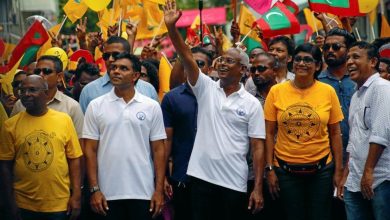
    Ibrahim Mohamed Solih, the opposition candidate for the presidency, with supporters at his final campaign rally
    Ibrahim Mohamed Solih, the opposition candidate for the presidency, with supporters at his final campaign rally

    By Dr Maheep

    As the wheel of Maldivian politics turns towards another critical juncture, the presidential elections slated for 9 September 2023, the national political landscape is abuzz with anticipation and preparations. During a recent press conference, the chairman of the Election Commission (EC), Fuad Thaufeeq, announced that if required, a second round of voting would take place on September 30. The nation stands on the cusp of a significant democratic exercise, one that promises to shape the future course of the island nation. According to the EC’s projections, the upcoming election will witness a larger voter turnout compared to the 2018 presidential election, with an estimated eligibility of over 280,000 individuals, surpassing the previous figure by approximately 21,000 voters. The crucial battle for the nation’s highest office is anticipated to unfold predominantly between the candidates representing the Maldivian Democratic Party (MDP) and the Progressive Party of Maldives (PPM).

    Situated primarily in the equatorial waters of the Indian Ocean, just south of the vast subcontinent of India, lies the Maldives. This exquisite archipelago, comprised of approximately 1,200 islands, cradles a population of close to half a million individuals.

    The incumbent, President Ibrahim Mohamed Solih, is set to run for re-election following his triumph over the Speaker of the People’s Majlis, Mohamed Nasheed, in the intense primary of the Maldivian Democratic Party (MDP) on Jan 30. Equally noteworthy in the upcoming electoral competition are the candidacies of former President Abdulla Yameen, who represents the Progressive Party of Maldives (PPM), and former Minister of Defence and National Security, Mohamed Nazim, who hails from the Maldives National Party. Along with them, the Jumhooree Party has also signalled its intent to enter the race by announcing plans to put forth its own presidential contenders.

    The 2019 parliamentary election in Maldives witnessed an extraordinary achievement by the Maldivian Democratic Party (MDP), as they secured a remarkable victory, winning 65 out of the 87 seats in the parliament. Under the leadership of Ibrahim Mohamed Solih, this historic win marked the first instance in Maldivian history where a single party gained such a substantial majority in the parliament. Alongside the MDP, Other notable parties in the parliament include the Jumhooree Party with five seats, the Progressive Party of Maldives (PPM) with five seats, the People’s National Congress (PNC) with three seats, and the Maldives Development Alliance with two seats. The remaining seven seats are held by independent representatives, further contributing to the diverse political landscape of the Maldivian parliament.

    Meanwhile, the PPM-PNC coalition in opposition has officially nominated their leader, former President Abdulla Yameen Abdul Gayyoom, as their candidate for the presidency. However, it is important to note that Yameen was convicted and sentenced to 11 years in prison by the Criminal Court on December 25 of the previous year on charges of corruption, money laundering and bribery in connection to the sale of V. Aarah – a case linked to the greater MMPRC graft case. As a result, Yameen’s participation in the upcoming presidential election is contingent upon the higher court overturning the verdict of the Criminal Court.

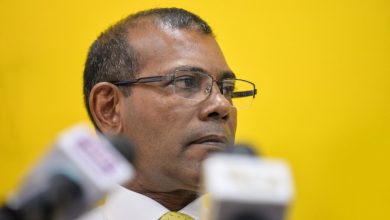
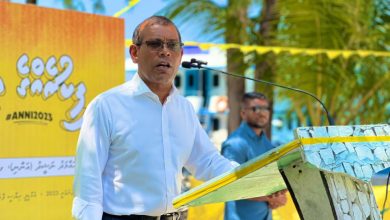
    Former President of the Maldives Mohamed Nasheed displays his candidate number with his fingers during a campaign rally ahead of the presidential runoff in Male.
    Former President of the Maldives Mohamed Nasheed displays his candidate number with his fingers during a campaign rally ahead of the presidential runoff in Male.

    Throughout his presidency and subsequent opposition, Yameen staunchly adopted an anti-India position, functioning as a proxy for Chinese interests in the Maldives. This was exemplified by his facilitation of numerous Chinese-backed infrastructure projects and agreements, some of which compromised the sovereignty of the island nation, such as the leasing of Feydhoo Finholu to a Chinese company. The China-Maldives Free Trade Agreement (FTA) serves as a glaring example of the situation. Without conducting proper due diligence on the associated projects, the Maldives joined China’s Belt and Road Initiative (BRI) by aligning itself with China’s Maritime Silk Road component, leading to a substantial increase in the country’s debt burden to China. Consequently, the Maldives essentially placed itself at the mercy of China’s salami-slicing strategy, wherein territories of other nations are incrementally acquired to advance China’s strategic interests. Furthermore, China’s interference in the internal affairs of the Maldives became pervasive during Yameen’s administration. Yameen’s governance not only undermined democratic practices but also perpetuated authoritarian rule, eroding the democratic foundations of the island nation.

    Under the leadership of Abdulla Yameen, the PPM government pushed Maldives into a precarious debt trap with China. Upon his release from house arrest in 2022, Yameen, supported by his political party members, launched a vitriolic “India-Out” campaign, baselessly alleging undue Indian influence over the incumbent government and accusing India of meddling in the affairs of Maldivian governance.

    President Solih’s administration revitalized the Maldives “India First” policy, emphasizing the reorientation of foreign policy towards India. The policy shift aimed to strengthen diplomatic ties with India and address the concerns over potential Chinese military encroachment in the region. Defence cooperation between the two nations was prioritized to enhance joint defence capabilities and regional stability. The economic relationship between the Maldives and India improved, with India providing significant lines of credit for infrastructure projects in the Maldives. The partnership was further fortified through India’s delivery of COVID-19 vaccines to the Maldives, demonstrating solidarity and fostering a deeper bond between the two nations. Overall, the policy shift has resulted in increased defence cooperation, enhanced economic collaboration, and a consolidated partnership between the two nations for mutual benefit and prosperity.

    In stark contrast to the PPM, the MDP has consistently prioritized the national interest of Maldives. Under the leadership of President Solih, the MDP has spearheaded indigenous development initiatives, exemplified by transformative infrastructure projects such as the Great Male Connectivity Project and the construction of an international airport in Hanimadhoo, HaaDhaalu atoll, aimed at bolstering the country’s vital tourism sector. The MDP envisions a socially progressive and economically thriving Maldives, firmly committed to fostering sustainable development.

    Moreover, the MDP has remained at the forefront of championing democratic ideals, advocating for human rights, social justice, and free and fair elections. In marked divergence to the PPM’s fiefdom-like practices under Yameen’s rule, which eroded democratic principles, the MDP not only upholds democratic values in governing the nation but also practices inner-party democracy. The MDP has been an unwavering voice against autocracy and corruption, while actively supporting the accountability and transparency of public institutions. It has steadfastly advocated for the rule of law and human rights, courageously combating religious extremism and the abuse of power. The MDP’s initiatives have led to tangible economic and social reforms that have directly improved the lives of countless Maldivians.

    The party has been particularly industrious in holding the government accountable for its social and economic development goals, ensuring that its representatives are answerable for their policies and actions. Through these efforts, the MDP has contributed significantly to the strengthening of democratic institutions and the establishment of participatory governance in the Maldives. A testament to its commitment to democratic principles is the democratic process witnessed in the presidential primary elections featuring the top leaders of the MDP, Solih and Nasheed. With its people-centric and progressive agenda, the MDP is poised to lead Maldives on a trajectory of continued development and prosperity within a robust democratic framework.

    The result of presidential primary election was a blow for Nasheed, who served as president from 2008 to 2012 and was the Maldives’ first democratically elected leader. Nasheed, aged 56, had aspired for a political resurgence following a conviction on charges of “terrorism,” widely regarded as politically motivated, which barred him from contesting in the previous presidential election in 2013.

    The simmering discord between Solih and Nasheed had been brewing for months, but tensions escalated when Nasheed openly declined to endorse Solih after losing in the primaries, indicating his intention to propose an alternative candidate. Going a step further, Nasheed initiated coalition discussions with Qasim Ibrahim, the leader of the Jumhooree Party. However, no official announcements have been made regarding a potential alliance between Nasheed and the Jumhooree Party.

    In a significant development, the upcoming Maldivian presidential election, set for September, is now at risk due to Speaker Mohammed Nasheed’s refusal to extend the Parliament session. This decision hampers the process of electing new members for the Election Commission, which currently faces a deadlock with a 3-2 vote against Chairman Fuad Taqfeeq. The responsibility to resolve these twin deadlocks falls upon President Ibrahim Solih, intervention of the Supreme Court, or both.

    Abdulla Yameen of the Progressive Party of Maldives (PPM)
    Abdulla Yameen of the Progressive Party of Maldives (PPM)

    A precarious situation has arisen following Nasheed’s formal departure from the ruling MDP, as he joined 13 loyalist Members of Parliament in the formation of a new party called “The Democrats.” The Democrats, comprising dissident members who broke away from the ruling Maldivian Democratic Party (MDP). Now they expressed their unwavering commitment on Monday to employ every possible means in order to secure the release of former President Abdulla Yameen Abdul Gayoom, who is presently serving an 11-year prison sentence for corruption, money laundering and other charges.

    During a press conference held on Monday afternoon subsequent to discussions between the Democrats and the main opposition party, Progressive Party of Maldives (PPM), Central Henveiru MP Ali Azim affirmed the Democrats’ endorsement of the right to a fair trial. He articulated the party’s contention that it is unjust for Yameen to bear the sole burden of imprisonment in a case that implicates multiple wrongdoers. Expressing concern over the conviction and incarceration of a solitary individual, Ali Azim emphasized the opposition leader’s entitlement to a fair judicial process. In response to a reporter’s query regarding the Democrats’ potential collaboration with the PPM in their efforts to secure Yameen’s release, Ali Azim hinted the party’s future involvement in such endeavours.

    Further elucidating the Democrats’ stance, Ali Azim clarified that while they were forging compromises to collaborate with the PPM, they did not endorse the PPM’s “India Out” movement. He accentuated that the convergence of principles between the two parties would necessitate time and gradual adjustment rather than an instantaneous transformation.

    During the press conference, the PPM and the Democrats disclosed their intention to hold a joint rally the following Monday, although the specific time and venue remain undisclosed. Besides, a joint committee comprising members from both parties has been established to engage in bipartisan discussions.

    In conclusion, the upcoming presidential elections in the Maldives mark a crucial turning point for the nation’s political landscape. With the MDP and the PPM as the primary contenders, the nation anticipates a significant voter turnout and a fierce battle for the highest office. The MDP, under President Ibrahim Mohamed Solih, has demonstrated a commitment to the national interest, indigenous development, and democratic values. In contrast, the PPM faces challenges due to the conviction of its leader, former President Abdulla Yameen, for money laundering and bribery. The emergence of breakaway factions and coalitions adds further complexity to the political landscape. Amidst this dynamic environment, the upcoming elections offer an opportunity for the Maldives to shape its future, reaffirm democratic principles, and pursue sustainable development within a robust democratic framework. Europe should seek to forge closer ties with the incoming Government in the Maldives. As a nation vulnerable to climate change – which is not of its own making – Europe should stand necessary to assist the Maldives with the challenges to come.

    Author: Dr Maheep, a leading Expert of India’s Foreign Affairs. He has been in teaching and research of International Relations and Global Politics over a decade.


  • Maldives’s MDP secures enough signatures to oust Speaker Nasheed

    Maldives’s MDP secures enough signatures to oust Speaker Nasheed

    Maldivian Democratic Party (MDP)'s parliamentary group holds a press conference on June 6, 2023. (Sun Photo/Mohamed Shaathiu Abdulla)
    Maldivian Democratic Party (MDP)’s parliamentary group holds a press conference on June 6, 2023. (Sun Photo/Mohamed Shaathiu Abdulla)

    Male: Maldivian Democratic Party (MDP) has gathered enough signatures to submit, and even pass a no-confidence motion to oust the party’s leader Mohamed Nasheed as the speaker of Parliament.

    MDP’s parliamentary group voted to submit a no-confidence motion against Nasheed on Tuesday, after weeks of concern from pro-government MDP members regarding how he runs the Parliament.

    A member of MDP’s parliamentary group told Sun that the no-confidence motion against Nasheed had received the endorsement of 50 MPs.

    The source said they were working on submitting the motion before the end of Tuesday.

    Parliament Speaker Mohamed Nasheed. (Sun Photo/Fayaz Moosa)
    Parliament Speaker Mohamed Nasheed. (Sun Photo/Fayaz Moosa)

    South Machangolhi MP Ahmed Haitham had tweeted earlier that the motion had secured 45 signatures.

    The decision to submit the no-confidence motion was taken after Nasheed decided to table the no-confidence motion against Attorney General Ibrahim Riffath, submitted by the opposition alliance over his alleged failure to act in the best interests of Maldives in the disputed maritime area between Maldives and Mauritius.

    The last half of the debate on the motion had been scheduled for Tuesday. However, the opposition Progressive Party of Maldives (PPM) submitted a motion against Riffath, accusing him of violating the Parliament’s privileges.

    The motion was rejected by MDP MPs, who hold a supermajority at the Parliament.

    The sitting was cut short after both sides launched into a verbal fight, resulting in loss of order.

    The Parliament has 55 MDP MPs other than Nasheed. 43 votes are required to pass the motion.

  • Maldives ex-President Nasheed leave MDP to form new party

    Maldives ex-President Nasheed leave MDP to form new party

    Maldivian Democratic Party (MDP) loyal to the party’s leader Mohamed Nasheed have left the party.
    Maldivian Democratic Party (MDP) loyal to the party’s leader Mohamed Nasheed have left the party.

    Male: Multiple members of the main ruling Maldivian Democratic Party (MDP) loyal to the party’s leader Mohamed Nasheed have left the party.

    The members who resigned from MDP include 12 MPs. They include Deputy Speaker Eva Abdulla, MP Mohamed Waheed, MP Imthiyaz Fahmy (Inthi), MP Hassan Latheef, MP Ilyas Labeeb, MP Yasir Abdul Latheef, MP Hassan Afeef, MP Ibrahim Rasheed (Bonde), MP Hussain Firushan, MP Hassan Shiyan, MP Mohamed Rasheed (Boadhigu), and MP Ahmed Zahir.

    They submitted their resignation letters Wednesday.

    The move comes after MDP’s parliamentary group had requested action against Inthi, Hassan Latheef, Ilyas, Yasir, and Central Henveiru MP Ali Azim earlier this week, for forming an alliance with the opposition Progressive Party of Maldives (PPM), Jumhoory Party (JP) and Maldives National Party (MNP), after accusing the government of failure to protect the interests of the Maldivian people in the case lodged with the International Tribunal of the Law of the Seas (ITLOS) over the disputed maritime territory between Maldives and Mauritius.

    The party’s disciplinary committee decided to expel Azim from the party on Tuesday.

    They are all members of Nasheed’s ‘Fikuregge Dhirun’ faction.

    However, Nasheed has yet to resign from the party.

    Despite the resignation of the 12 MPs, President Ibrahim Mohamed Solih continues to hold full control of the Parliament with 56 MPs.

    MDP's leader and Parliament Speaker, Mohamed Nasheed.
    MDP’s leader and Parliament Speaker, Mohamed Nasheed.

    The main ruling Maldivian Democratic Party (MDP)’s leader Mohamed Nasheed has decided to form a new political party.

    Nasheed initiated a separate political movement within MDP, ‘Fikuregge Dhirun’, following his loss in MDP’s presidential primary held back in January. After major conflicts with the government and its policies – all lawmakers from the faction tendered their resignation from MDP on Wednesday.

    The move came after Central Henveiru MP Ali Azim was expelled from the party on Tuesday and banned from rejoining for at least one year over involvement in opposition political activities surrounding the Chagos archipelago dispute.

    The 12 members who resigned from MDP on Wednesday are;

    Parliament’s Deputy Speaker, North Galolhu MP Eva Abdulla
    Ungoofaaru MP Mohamed Waheed (Wadde)
    North Maafannu MP Imthiyaz Fahumy (Inthi)
    West Henveiru MP Hassan Latheef
    Hulhudhoo MP Ilyas Labeeb
    North Kulhudhuffushi MP Yasir Abdul Latheef
    Vilufushi MP Hassan Afeef
    Central Maafannu MP Ibrahim Rasheed (Bonde)
    Madaveli MP Hussain Firushan
    Thoddoo MP Hassan Shiyan (Gita)
    North Mahchangoalhi MP Mohamed Rasheed (Boadhigu)
    Gadhdhoo MP Ahmed Zahir
    All 12 members a close acquittances of Nasheed. MP Hassan Latheef, during a meeting at Bodufenvalhuge on Wednesday, announced Nasheed’s decision to form a new political party. The meeting was attended by supporters of Nasheed.

    Should Nasheed form a new political party, that party would will be the largest opposition party in terms of members in the parliament. The opposition PPM-PNC coalition only has eight members in the parliament.

  • Maldives Speaker requests MPs not to withdraw requests to question cabinet ministers

    Maldives Speaker requests MPs not to withdraw requests to question cabinet ministers

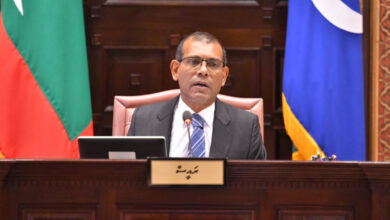
    Parliament Speaker, former President Mohamed Nasheed presides over a parliamentary sitting. (Photo/People's Majlis)
    Parliament Speaker, former President Mohamed Nasheed presides over a parliamentary sitting. (Photo/People’s Majlis)

    Male: Maldives Parliament Speaker Mohamed Nasheed has asked MPs not to withdraw their requests to question cabinet ministers.

    The Parliament today scheduled to question Home Minister Imran Abdulla on the request of Nolhivaram MP Mohamed Nasheed Abdulla. However, the MP withdrew the question sometime last night. MP Mohamed Nasheed has previously withdrawn questions after moving to question ministers.

    “Honorable member, you have acted in this way even before. When you do this, other honorable members lose the chance to question the minister despite being in the queue,” Speaker Nasheed said.

    The Speaker said there is already a long list of MPs who have requested to question over 20 cabinet ministers.

    Nasheed said that heads of SOEs aren’t political appointees, and that it isn’t necessary their vision and the company direction align with the government’s policies.

    Maldives parliament
    Maldives parliament

    “I am certain their vision and the company direction shouldn’t be linked to the whims of political heads of the government,” he said.

    Nasheed added that SOEs spend more than the state budget, and need more funds for their payroll than the civil service.

    He said that a huge chunk of taxpayer money goes into repayment of loans taken by SOEs, which is sometimes higher than state spending on health and education.

    Nasheed’s comments come after State Trading Organization (STO)’s managing director Hussain Amr Mohamed Rashad was dismissed last week, after he refused to back President Solih’s re-election and aligned himself with Nasheed instead.

    Amr was dismissed by the Privatization and Corporatization Board (PCB) at President Solih’s direct orders.