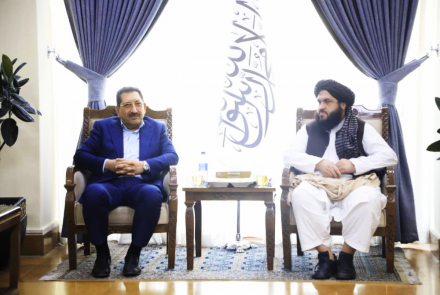
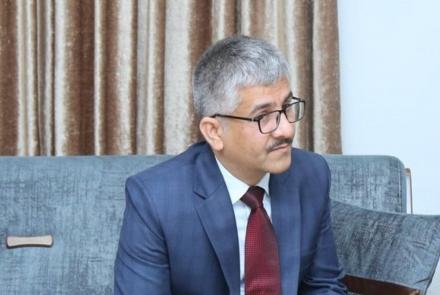
Karan Yadav, who previously headed India’s technical mission in Kabul, has now been appointed as the chargé d’affaires at the Indian Embassy in Kabul.
Kabul : Following the upgrade of diplomatic relations between India and Afghanistan, Indian media outlets reported that India has appointed a new chargé d’affaires for its embassy in Afghanistan after four years.
According to reports, Karan Yadav, who previously headed India’s technical mission in Kabul, has now been appointed as the chargé d’affaires at the Indian Embassy in Kabul.
Moeen Gul Samkanai, a political analyst, stated: “India is one of the regional superpowers and a member of organizations such as BRICS and the Shanghai Cooperation Organization. Therefore, we must maintain regional and international relations with them.”
The appointment of India’s chargé d’affaires to Afghanistan comes a day after the spokesperson of the Islamic Emirate of Afghanistan also described the strengthening of diplomatic relations with India as a sign of growing diplomatic engagement between the two countries.
Mohammad Ebrahim Fekrat Asadi, another political analyst, commented: “The recent tensions between Afghanistan and Pakistan prompted India to elevate its relations with Afghanistan, which also benefits India.”
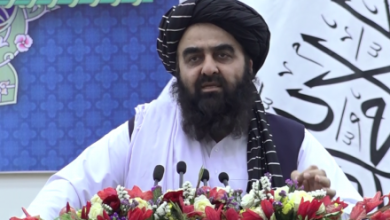
Although over the past four years, relations between India and the Islamic Emirate of Afghanistan have been minimal, the recent visit of Amir Khan Muttaqi, the Islamic Emirate of Afghanistan’s foreign minister, to New Delhi appears to have opened the door for expanding ties with India.
An Afghan girl carries water containers along a street in Argo district of Badakhshan Province, Afghanistan. (AFP)
KABUL: Eight-year-old Noorullah and his twin, Sanaullah, spend their days hauling yellow jerrycans on a wheelbarrow through Kabul’s dusty alleys instead of going to school — an ordeal for one family that reflects Afghanistan’s deepening water crisis.
Once supplied with water from their own well, the family of 13 has had to queue at communal taps or pool money for costly water tankers since their supply dried up four years ago.
With climate change increasing the frequency of droughts and erratic rainfall in Afghanistan, aid agencies say Kabul is among the most water-stressed cities in Asia, with shortages fueling disease, malnutrition and school dropouts.
The Afghanistan Analysts Network, an independent Kabul-based research group, in a report this month warned the city’s groundwater could run out by 2030, with other Afghan cities also running dry. The crisis is deepening inequality, as poor families spend up to 30 percent of their income on tanker water while the wealthy dig ever-deeper private wells.
The twin boys queue with dozens of children at a communal tap, where shoving and shouting often flare into fights as the heat builds.
STANDING IN LINE FOR HOURS
Noorullah, who has epilepsy, said he once collapsed with a seizure while fetching water. His brother added, “Sometimes we stand in line for three hours. When the heat is too much, we feel dizzy.”
Their father, 42-year-old shopkeeper Assadullah, feels there is no choice. Sitting outside his small shop with empty water barrels stacked nearby, he said, “From morning until evening, my children go for water six or seven times a day.”
“Sometimes they cry and say they cannot fetch more, but what else can we do?“
The shortages have gutted his income too. On a good day, he earns $2–$3, however, he often closes the shop to help his sons push their loads.
“Before, we used to receive water through a company. It lasted us three or four days. Now even that option is gone,” he said.
In the family’s yard, his wife, Speray, washes dishes in a plastic basin, measuring out each jug. She said her husband has developed a stomach ulcer and she contracted H. pylori, a bacterial infection linked to unsafe water. “I boil water twice before giving it to our children, but it is still a struggle,” she said.
SNOWMELT ONCE REPLENISHED KABUL’S WATER BASIN
Kabul’s population has surged past six million in two decades, but investment in water infrastructure has lagged. War wrecked much of the supply network, leaving residents dependent on wells or costly tankers, and those are failing.
Just a few streets from Assadullah, 52-year-old community representative Mohammad Asif Ayubi said more than 380 households in the neighborhood faced the same plight. “Even wells 120 meters (nearly 400 feet) deep have dried up,” he said, a depth once considered certain to reach water.
Droughts and erratic rainfall patterns have limited the snowmelt that once replenished Kabul’s water basin and left the riverbed dry for much of the year. “Kabul is among the most water-stressed areas,” said Najibullah Sadid, a water researcher based in Germany.
UN envoy Roza Otunbayeva warned the UN Security Council earlier this month that droughts, climate shocks and migration risk turning Kabul into the first modern capital to run out of water “within years, not decades.”
For Assadullah, the wish is simple. “If we had enough water, my children wouldn’t have to run around all day,” he said. “They could go to school. Our whole life would change.”
The Iranian Minister stated that his country intends to expand its trade relations with all neighboring countries, particularly Afghanistan.
Kabul : A high-level delegation led by Seyyed Mohammad Atabak, Iran’s Minister of Industry, Mines, and Trade, arrived in Kabul this morning.
The Iranian Minister stated that his country intends to expand its trade relations with all neighboring countries, particularly Afghanistan.
Referring to the shared historical ties between Iran and Afghanistan, Mr. Atabak emphasized Iran’s commitment to enhancing economic and commercial cooperation with Afghanistan.
He said: “We intend to pursue the plans we have laid out during our meetings with Afghan government officials to elevate the level of exchanges and strengthen bilateral cooperation, and to initiate new programs as well.”
Meanwhile, Afghanistan’s Ministry of Industry and Commerce described the purpose of the visit as reviewing existing challenges to bilateral trade and exploring ways to facilitate transit and joint investment between the two countries.
Akhundzada Abdul Salam Jawad, spokesperson for the ministry, said: “The delegation is scheduled to meet with the economic deputies of the Ministries of Industry and Commerce, Mines and Petroleum, and Public Works of the Islamic Emirate, as well as members of Afghanistan’s private sector.”
On the other hand, the Afghanistan Chamber of Commerce and Investment (ACCI) welcomed the visit as a step toward strengthening economic cooperation between Kabul and Tehran. However, it also stressed the importance of addressing challenges related to Afghanistan’s exports and transit of goods to Iran during talks with the delegation.
Jan Agha Nawid, spokesperson for the ACCI, said: “The arrival of this high-ranking Iranian delegation, led by the Minister of Industry, Mines, and Trade, is a positive step in our trade and economic relations with our neighboring country. The Chamber’s position is that we must expand our economic and commercial ties with neighboring countries, the region, and the world.”
Currently, the trade volume between Iran and Afghanistan exceeds $3.5 billion, yet Afghanistan’s share in these exchanges remains notably small.
Zakir Jalali wrote on X that both sides are interested in resolving issues and that the presence of Zalmay Khalilzad in the U.S. delegation was useful.
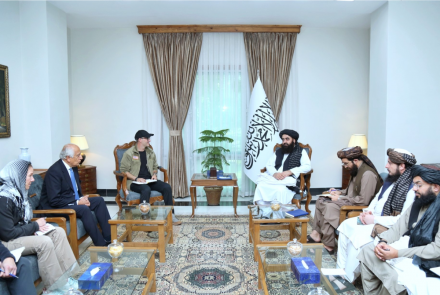
Kabul : One day after the U.S. delegation’s visit to Kabul, reports have emerged of an agreement between the two sides on a prisoner exchange.
The talks took place on Saturday, September 14, between Adam Boehler, U.S. Special Envoy for Hostage Affairs, and Zalmay Khalilzad, former U.S. envoy for Afghanistan, with Amir Khan Muttaqi, the Acting Foreign Minister.
Hamdullah Fitrat, Deputy Spokesman of the Islamic Emirate, said: “Adam Boehler, referring to the issue of detainees in Afghanistan and the United States, stated that both countries will exchange their prisoners.”
Sayed Zia Hosseini, an international relations analyst, said: “The release of American citizens who are imprisoned under any circumstances is an opportunity for the Islamic Emirate to expand its engagement.”
The Third Political Director of the Ministry of Foreign Affairs also commented on this visit, saying there are no serious obstacles in relations between Kabul and Washington.
Zakir Jalali wrote on X that both sides are interested in resolving issues and that the presence of Zalmay Khalilzad in the U.S. delegation was useful.
Mr. Jalali said: “After the withdrawal of American forces from Afghanistan, there are no serious obstacles in bilateral relations that cannot be resolved. If we compare Vietnam-U.S. relations after America’s withdrawal from Saigon with current Kabul-Washington relations, Kabul and Washington are in a better position. The fact that the U.S. delegation has opened its doors to Kabul marks a new and more serious phase in continuing negotiations.”
Abdul Mabood Hujjati, a political analyst, said: “The more dialogue and discussion take place, the more mistrust will be removed and relations will expand. Gradually, diplomatic and political relations will transform into economic ones.”
Sayed Qaribullah Sadat, another political analyst, said: “From a security perspective and given Afghanistan’s current situation, it is necessary for Americans and Europeans, like Islamic and Asian countries, to engage with the Islamic Emirate, because Afghanistan today has emerged from a state of war.”
This marks the second visit of a U.S. delegation to Kabul within a year. Yesterday, Adam Boehler and his accompanying delegation met with senior officials of the Islamic Emirate, including Mullah Abdul Ghani Baradar, Deputy Prime Minister for Economic Affairs, and Amir Khan Muttaqi, the Foreign Minister.
Afghan residents inspect near a damaged house after overnight aerial strikes in the Shinwar district of Nangarhar Province on August 28, 2025. Afghanistan’s Taliban government accused Pakistan on August 28 of carrying out air and drone strikes in two border provinces overnight that killed three people, summoning Islamabad’s ambassador to complain. (Photo by AFP)
ISLAMABAD: Airstrikes that Afghanistan’s Taliban government blamed on neighboring Pakistan struck two eastern provinces of the country, killing at least three people, wounding seven others and damaging homes, officials and witnesses said Thursday.
In Kabul, the foreign ministry decried the strikes that took place late Wednesday in Nangarhar and Khost provinces, calling them a “provocative act” by Pakistan and summoning the Pakistani ambassador in Kabul.
The Afghan Defense Ministry also condemned the strikes. “Such barbaric and brutal actions benefit neither sides; rather intensify the distance between the two Muslim nations and fuel hatred. These irresponsible activities will have consequences,” it wrote on the X social media platform.
Neither the Pakistani government nor the military commented on the alleged strikes.
Kabul previously has accused Pakistan of launching airstrikes in Afghanistan against suspected hideouts of the Pakistani Taliban, a militant group banned in Pakistan and blamed for some of that country’s deadliest terrorist attacks.
In Nangarhar’s Shinwari district, members of a family whose house was reduced to rubble sifted through the debris to try to recover what they could.
“They dropped the first big bomb on my house. My house was completely destroyed,” said Shah Sawar, a resident of Nangarhar’s Shinwari district. “First I pulled a child out of the rubble, then I pulled four children and a woman out.”
Nangarhar’s deputy governor, Maulvi Azizullah Mustafa, said the strikes were fired by Pakistani drones. The Afghan foreign ministry said three people were killed and seven wounded in Nangarhar and Khost.
Kabul in December 2024 accused Pakistan of carrying out airstrikes against suspected hideouts of the Pakistani Taliban in Paktika province. Pakistan also did not acknowledge those strikes at the time. Kabul claimed hitting several points inside Pakistan in retaliation.
The latest violence comes a week after top diplomats from Pakistan, China and Afghanistan met in Kabul and pledged closer cooperation against terrorism. It also came three months after Pakistan and Afghanistan upgraded their diplomatic ties to improve bilateral relations.
However, relations between Islamabad and Kabul have remained tense since 2021, when the Afghan Taliban seized power, mainly over Kabul’s alleged support of the Pakistani Taliban, who have stepped up attacks on security forces and civilians in Pakistan in recent years.
Pakistan accuses Afghanistan of harboring the Pakistani Taliban, which is separate but closely allied to the Afghan Taliban. Kabul denies that, saying it does not allow anyone to use its soil against another country.
The Ministry of Industry and Commerce of Afghanistan has announced that Pakistani authorities have agreed to the immediate release of seized assets of Afghan traders in the port of Karachi.
By Bibi Amina Hakimi, TOLOnews’ Reporter
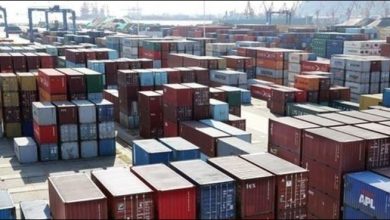
Kabul: One and a half months have passed since Pakistan imposed restrictions on Afghan transit goods in Karachi, and hundreds of merchant containers are stopped at Karachi port.
The spokesman of the Ministry of Industry and Commerce said that a delegation of the Islamic Emirate in a meeting with Pakistan officials reached an agreement on the transfer of Afghan transit goods in the port of Karachi.
Nooruddin Azizi, acting Minister of Industry and Commerce of the Islamic Emirate of Afghanistan, led a delegation to Pakistan in a bilateral meeting.
“The Ministers of Foreign Affairs and Trade of Pakistan were present at this meeting. It was agreed that the transit goods of Afghan businessmen stopped at the port of Karachi should be released,” said Akhundzada Abdul Salam Jawad.
The Afghanistan-Pakistan Joint Chamber of Commerce said that currently only containers stuck in Karachi port will be allowed to move.
“But in the future, it will be discussed again what the new situation and conditions will be. For now, the problems of these containers have been solved. If it continues like this, I think Afghans will not use this way,” said Khanjan Alokozai, head of the Afghanistan-Pakistan Joint Chamber of Commerce.
Meanwhile, the spokesperson of the Ministry of Foreign Affairs of Pakistan said that meetings of the officials of the country with a delegation from the current government of Afghanistan have also addressed facilitating the trade and transit sectors.
“In the meeting, discussions about investment in the private and public sector, transit, trade at crossings, and preventing obstacles in the trade sector were discussed,” said Pakistan Foreign Ministry spokesperson Mumtaz Zahra Baloch.
Earlier, the Afghanistan-Pakistan Joint Chamber of Commerce said that the recent restrictions imposed on the country’s transit goods at the port of Karachi have caused a loss of more than twenty million dollars to the country’s merchants.
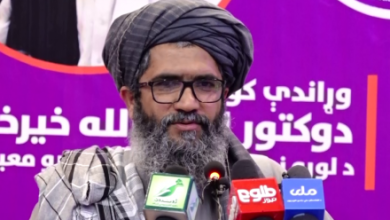
The scientific deputy of the Ministry of Higher Education, Lutfollah Khairkhwah
Kabul: Some Islamic Emirate officials called on Islamic countries and the international community to clarify their position against Israel’s attacks on the Gaza Strip.
The scientific deputy of the Ministry of Higher Education, Lutfollah Khairkhwah, said during a scientific seminar in Kabul titled “Intellectual Education for Youth” that certain nations, particularly the United States, consider Israel’s war against Palestine to be legitimate.
Khairkhwah said that Islamic countries have remained silent and have not taken a stand on this issue.
“America stood by Israel and is directly involved in the war and says that Israel has a legal right to defend itself and all Islamic countries look at it, and they can’t even take a position to say that this war should end,” Khairkhwah noted.
Speaking at the seminar, the deputy also asked youth to fulfill their responsibilities toward society and consider intellectual and moral principles.
“In our Islamic countries, a gap has been created between our history, culture and societies. The third issue is the true sense of responsibility that has disappeared and this feeling must be restored,” Khairkhwah added.
“It is the responsibility and mission of universities to work on the minds of youth,” said Sayed Abdul Hakim Hekmat, chancellor of Bayazid Rokhan University.
The scientific deputy of the Ministry of Higher Education, Lutfollah Khairkhwah, added that all students who return to Afghanistan from neighboring countries, especially Pakistan, will be provided with higher education.
Some professors who participated the seminar said that holding scientific seminars is important for youth and asked the officials to hold more such programs.
“A kind of science is useful for Muslim youth which has intellectual thought; without intellectual thought, all sciences are incomplete,” said Rahmatullah Seial, a university lecturer.
Earlier, the Deputy Minister of Youth Affairs of the Ministry of Information and Culture announced the approval of a decree in the intellectual education department of the youth by the leader of the Islamic Emirate.
The acting Minister of Foreign Affairs, Amir Khan Muttaqi
Kabul: The acting Minister of Foreign Affairs, Amir Khan Muttaqi, said that weakening the Afghan government will harm everyone and that the international community has assured the Islamic Emirate that they don’t support the armed resistance against the interim government.
Speaking at a large gathering of religious clerics and influential figures of the country, Muttaqi said that Afghan soil is not a threat to any country and there is a need for the international community have a moderate policy towards the Islamic Emirate.
“There is no opposition all over Afghanistan. The whole world assured us that they don’t support the armed opponents. This opportunity should be used considering the policy of the Islamic Emirate and its moderate policy which doesn’t want Afghanistan to become a battlefield for negative powers,” he said.
Addressing the same gathering, the country’s Interior Minister, Sirajuddin Haqqani, called on the people to support the Islamic Emirate.
“The reconstruction needs patience and major engagement. Bullying has ended and a pure independence has been ensured,” he said.
The participants issued a resolution of 12 principles, in which they also stressed the facilitation of religious and modern education based on Sharia and Afghan culture.
The statement also stresses the need for engagement of the Islamic Emirate with the international community within a Sharia and Islamic framework. They also called for releasing Afghanistan’s assets abroad and lifting sanctions as well as economic cooperation by the international community.
“The Ulema and influential figures wants the Islamic Emirate to take necessary actions for engagement with the world while considering Islamic Sharia, independence, reputation of Afghanistan, national reconciliation and based on the current conditions,” said Sultan Ahmad Adel, head of the Ulema council at 22nd PD in Kabul.
“We are opposing modern education. We need medical, science, physics, chemistry, and biology,” said Deen Mohammad, head of the Kabul Ulema.
The gathering of the religious clerics and influential figures comes as the international community has repeatedly called for national consensus and national dialogue in Afghanistan in a bid to solve the ongoing challenges of the country.
A girl looks on among Afghan women lining up to receive relief assistance, during the holy month of Ramadan in Jalalabad, Afghanistan, June 11, 2017. REUTERS/Parwiz – RC19526F6FC0.
By C UDAY BHASKAR
Afghan women were dealt yet another body blow by the Taliban regime which declared that women were not observing the hijab regulations inside parks in the prescribed manner and hence, would be forbidden from entering such recreation spots.
Mohammad Khaled Hanafi – Afghanistan’s acting minister of virtue and vice – made this announcement on 26 August after noticing the ‘transgression’ by some women at the well-known Band-e-Amir National Park.
He further added that it “was not obligatory” to visit parks for sightseeing and that a solution would soon be found – presumably one that would place further fetters on the hapless women and girl children of Afghanistan who are already reeling under the gender apartheid policies of the Taliban.
afghan women
Women Remain a Target of the Taliban
Multiple ironies and tragedies mark the plight of the Afghan people and women in particular since the Taliban returned to power in Kabul in August 2021.
Over the last two years, it is evident that the Afghan issue has gone off the radar of the major powers, and barring anodyne references at multilateral summits and at the UN that are made periodically – the women of Afghanistan have been abandoned to the misogynistic mercy of the Taliban regime.
The shambolic US withdrawal announced by President Joe Biden soon after he assumed office – was symptomatic of this costly US fatigue and a cynical acceptance by the White House that despite the blood and treasure expended since October 2001, socio-cultural rhythm change in Afghanistan was not a feasible proposition.
Liberal voices within Afghanistan have been stifled – in extreme cases, even killed – and there is no discernible light at the end of the tunnel.
Afghanistan Isn’t Brought Up in BRICS
In keeping with this erasure of the Afghan woman from the larger global consciousness, it was both intriguing and disappointing that there was no reference at all to Afghanistan in the recently concluded BRICS summit in South Africa.
The 94-paragraph document comprising 9276 words touched upon various issues and some of the troubled conflict-ridden regions of the world – but Afghanistan was missing.
It merits recall that at the BRICS 2021 summit chaired by India, Afghanistan received empathetic notice from the five-member group (Brazil, Russia, China, and South Africa being the other four), and at that time, the leaders sought an “inclusive intra-Afghan dialogue so as to ensure stability, civil peace, law, and order.”
The 2022 BRICS summit chaired by China devoted a whole paragraph to the Afghan issue and noted: “We strongly support a peaceful, secure, and stable Afghanistan while emphasizing the respect for its sovereignty, independence, territorial integrity, national unity, and non-interference in its internal affairs. We emphasise the need for all sides to encourage the Afghanistan authorities to achieve national reconciliation through dialogue and negotiation, and to establish a broad-based inclusive, and representative political structure. We reaffirm the significance of relevant UNSC resolutions.”
It also states, “We emphasise that the Afghan territory not to be used to threaten or attack any country or to shelter or train terrorists, or to plan to finance terrorist acts, and reiterate the importance of combating terrorism in Afghanistan. We call on the Afghanistan authorities to work towards combating drug-related crime to free Afghanistan from the scourge of drugs. We stress the need to provide urgent humanitarian assistance to the Afghan people and to safeguard the fundamental rights of all Afghans, including women, children, and different ethnic groups.”
Sidestepping the Afghan Issue
The SCO (Shanghai Cooperation Organisation) which has a regional and counter-terrorism focus has in the past, taken note of the intractable Afghan issue at its summits and it is instructive that India, Russia, and China are the three major nations who are part of both BRICS and the SCO.
While they have provided bilateral support to Afghanistan over the decades, there has been no RIC (Russia, India, China) consensus about harmonisng their efforts in a tangible manner to realise their declaratory positions – particularly as related to the contentious issue of Afghan gender equity.
The 2022 BRICS summit chaired by China devoted a whole paragraph to the Afghan issue and noted: “We strongly support a peaceful, secure, and stable Afghanistan while emphasizing the respect for its sovereignty, independence, territorial integrity, national unity, and non-interference in its internal affairs. We emphasise the need for all sides to encourage the Afghanistan authorities to achieve national reconciliation through dialogue and negotiation, and to establish a broad-based inclusive, and representative political structure. We reaffirm the significance of relevant UNSC resolutions.”
It also states, “We emphasise that the Afghan territory not to be used to threaten or attack any country or to shelter or train terrorists, or to plan to finance terrorist acts, and reiterate the importance of combating terrorism in Afghanistan. We call on the Afghanistan authorities to work towards combating drug-related crime to free Afghanistan from the scourge of drugs. We stress the need to provide urgent humanitarian assistance to the Afghan people and to safeguard the fundamental rights of all Afghans, including women, children, and different ethnic groups.”
Sidestepping the Afghan Issue
The SCO (Shanghai Cooperation Organisation) which has a regional and counter-terrorism focus has in the past, taken note of the intractable Afghan issue at its summits and it is instructive that India, Russia, and China are the three major nations who are part of both BRICS and the SCO.
While they have provided bilateral support to Afghanistan over the decades, there has been no RIC (Russia, India, China) consensus about harmonisng their efforts in a tangible manner to realise their declaratory positions – particularly as related to the contentious issue of Afghan gender equity.
With India preparing to host the G20 summit from 8 to 10 September, one hopes that there will be the appropriate degree of high-level political attention accorded to Afghanistan and its stoic women who have borne the brunt of cruel and grossly iniquitous gender policies.
The brave women teachers in Afghanistan who continue to teach the girl child secretly despite the Taliban diktat merit a salute for keeping the flickering flame alive. Their plight and resolve should not be erased from the collective global memory.
(Commodore C Uday Bhaskar, Director, Society for Policy Studies, has the rare distinction of having headed three think tanks. He was previously Director at the National Maritime Foundation (2009-11) and the Institute for Defence Studies and Analyses (2004-05). He tweets @theUdayB. This is an opinion piece. The views expressed above are the author’s own. The Quint neither endorses nor is responsible for them.)
Kabul: The fall of Kabul was a military and political “failure” of America, a spokesman for China’s foreign ministry said on the anniversary of the Islamic Emirate’s two-year rule.
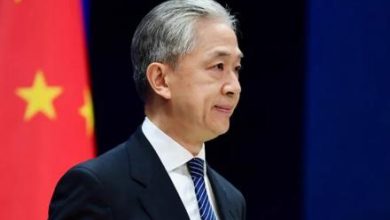
Addressing a press conference on Tuesday, August 15, Chinese foreign ministry spokesperson Wang Wenbin said that Afghanistan has been stable for two years and the future of this country is now back in the hands of its people.
“What happened in Afghanistan marked a military, political and counter-terrorism failure of the US in Afghanistan, and once again proved that military intervention, political infiltration and “democratic transformation” from the outside will not work and will only breed turmoil and disaster,” Wenbin noted.
The spokesperson added that the international community expects the Islamic Emirate to fulfill its commitments to form a comprehensive government, ensure the rights of women and ethnic minorities, and prevent terrorist activities in Afghanistan.
“The international community still has expectations for Afghanistan in building a more broad-based and inclusive government framework and safeguarding the rights and interests of all its citizens, including women and ethnic minorities,” Wang Wenbin added.
The Islamic Emirate has not yet complied with the requests of the international community regarding women’s rights.
In reaction to restrictions on women in Afghanistan, António Guterres, Secretary-General of the UN, said: “It is now two years since the Taliban takeover of Afghanistan & the situation in the country remains deeply troubling, including the severe restrictions imposed on the rights of women & girls. The international community must not forget the people of Afghanistan.”
But the Islamic Emirate spokesman said that women’s rights have been ensured in the country.
“We have never violated human rights; the rights that people possess are assessed in accordance with the Islamic Sharia, and they will definitely be granted to them. We are also defending people’s rights,” Mujahid said.
Although two years of the Islamic Emirate have passed in the country, the world does not recognize it due to what the world sees as the violation of human rights and the non-establishment of a inclusive government in the country.
However, the Islamic Emirate has consistently highlighted that, in accordance with Islamic law, women’s rights are upheld, and the formation of an inclusive government is one of Afghanistan’s internal issues.