Tag: India

  • Pakistan welcomes India’s Sikh pilgrims, first since May war

    Pakistan welcomes India’s Sikh pilgrims, first since May war

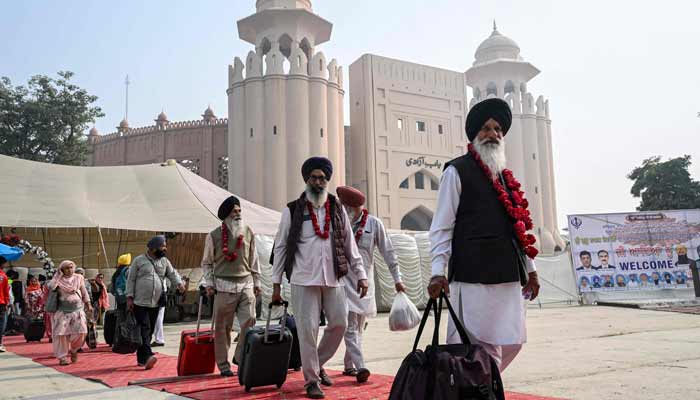
    Indian Sikh pilgrims arrive in Pakistan after crossing the India-Pakistan Wagah border in Wagah on November 4, 2025, on the eve of celebrations marking the birth anniversary of Guru Nanak, founder of Sikhism. — AFP
    Indian Sikh pilgrims arrive in Pakistan after crossing the India-Pakistan Wagah border in Wagah on November 4, 2025, on the eve of celebrations marking the birth anniversary of Guru Nanak, founder of Sikhism. — AFP

    Islamabad: Pakistan on Tuesday welcomed dozens of Sikh pilgrims from India, AFP journalists saw, in the first major crossing since deadly clashes in May closed the land border between the nuclear-armed neighbours.

    More than 2,100 pilgrims were granted visas to attend a 10-day festival marking the 556th birth anniversary of Guru Nanak, founder of the Sikh faith, Pakistan’s High Commission in New Delhi said last week.

    Tensions remain high between Islamabad and New Delhi after the worst fighting since 1999 took place in May, with scores losing their lives following India’s unprovoked attacks.

    The Wagah-Attari border — the only active land crossing between the two countries — was closed to general traffic following the violence.

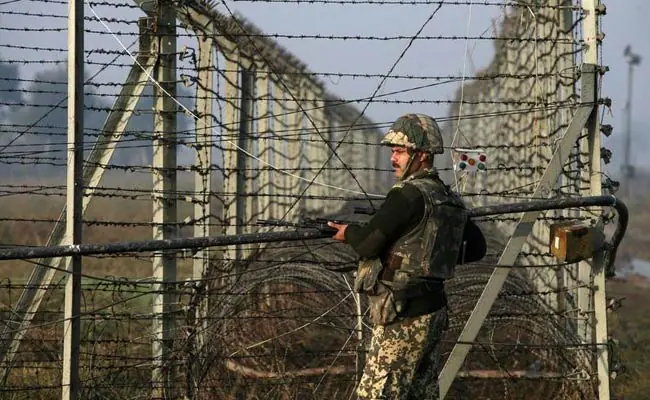
    Pilgrims queued up on the Indian side of the border on Tuesday morning, some carrying their luggage on their heads, as the Indian Border Security Force looked on.

    AFP journalists on the Pakistani side of the Wagah-Attari border saw dozens of them entering Pakistan.

    They were received by Pakistani officials who presented them with flowers and showered them with rose petals.

    Indian media reported that around 1,700 were due to cross into Pakistan, although there was no immediate official confirmation from Indian authorities.

    The pilgrims will gather on Wednesday at Nankana Sahib, Guru Nanak’s birthplace, about 80 kilometres west of Lahore by road, and later visit other sacred sites in Pakistan, including Kartarpur, where the guru is buried.

    Pakistan’s High Commission had said last week its decision was consistent with efforts to promote “inter-religious and inter-cultural harmony and understanding”.

    Indian newspapers reported Saturday that the government would allow “selected” groups to travel to Pakistan.

    The Kartarpur Corridor, a visa-free route that opened in 2019, which allows Indian Sikhs to visit the temple without crossing the main border, has remained closed since the conflict.

    The four-day clashes between the arch-rivals broke out in May after New Delhi accused Islamabad of backing an attack targeting tourists in Indian Illegally Occupied Jammu and Kashmir (IIOJK) on April 22, claims Pakistan denied.

    Sikhism is a monotheistic religion born in the 15th century in Punjab, a region spanning parts of what is now India and Pakistan.

    The frontier between the two countries was a colonial creation drawn at the violent end of British rule in 1947, which sliced the subcontinent into Hindu-majority India and Muslim-majority Pakistan.

    While most Sikhs migrated to India during partition, some of their most revered places of worship ended up in Pakistan, including the shrines in Nankana Sahib and Kartarpur.

  • India, ASEAN to boost economic stability through sustainable tourism

    India, ASEAN to boost economic stability through sustainable tourism

    Kuala Lumpur [Malaysia], October 26 (ANI): India and ASEAN nations on Sunday said sustainable tourism should not only protect the environment but also strengthen the economic foundations of local communities.

    Adopting the ‘ASEAN-India Joint Leaders’ Statement on Sustainable Tourism’ during the 47th ASEAN Summit in Malaysia, leaders pledged to promote eco-friendly and inclusive tourism that supports long-term economic stability and community development across the region.

    The statement highlighted the need to promote viable, sustainable economic activities that create stable employment, fair income opportunities, and an equitable distribution of benefits among all stakeholders.

    The joint statement noted that economic stability is central to sustainable tourism and called for promoting resilient business models, community-led tourism, and investment opportunities that ensure steady livelihoods, particularly for women and youth.

    The joint statement on economic stability noted four major points: “promote viable, sustainable economic operations, and provide socioeconomic benefits to all stakeholders that are fairly distributed, including stable employment and income-earning opportunities.”

    The leaders stressed the importance of involving local communities in tourism promotion, offering skill training, and encouraging ownership of tourism initiatives to maximise economic prosperity. They agreed that tourism should directly improve living standards by generating jobs, expanding entrepreneurship, and fostering inclusive growth.

    “Tourism can be a strong driver of stability and development when its benefits reach everyone, from local workers to small businesses,” the statement noted.

    Another key focus was encouraging ecotourism that balances the needs of tourists and residents, helping prevent overcrowding and over-exploitation of natural sites. The statement called for the participation of women and youth in the ecotourism process to make the sector more inclusive.

    The leaders also agreed to support data-driven tourism development by improving digital infrastructure at tourist destinations, using new technologies to enhance visitor experience, and analysing tourist flow to make informed policy decisions.

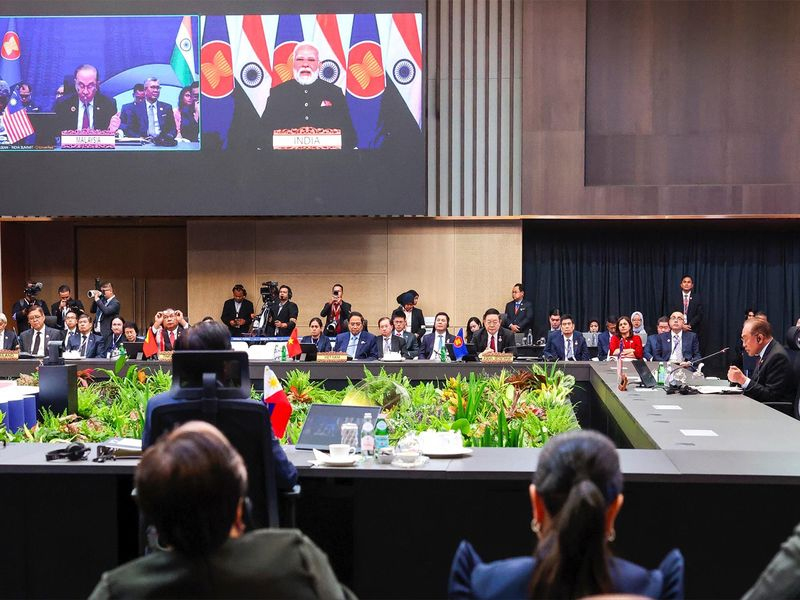
    In his virtual address to the summit, Prime Minister Narendra Modi said the 21st century belongs to India and ASEAN, describing the bloc as a major pillar of India’s Act East Policy. He also declared 2026 as the Year of ASEAN-India Maritime Cooperation to strengthen regional connectivity and ocean-based economic activities.

    “The 21st century is our century, the century of India and ASEAN,” PM Modi said in his virtual address to the 22nd ASEAN-India Summit in Kuala Lumpur in Malaysia, stressing the deep-rooted historical, cultural, and civilizational bonds.

    He congratulated Malaysia and its Prime Minister, Anwar Ibrahim, on successfully hosting the 47th ASEAN Summit, and commended the Philippines for serving as the country coordinator for India. Further, he welcomed East Timor’s inclusion as the 11th member state of the ASEAN community.

    “Even in this era of uncertainty, the India-ASEAN Comprehensive Strategic Partnership has shown steady progress,” PM Modi said, adding that both sides are “fellow travellers in the Global South, working together for stability, growth, and prosperity.” (ANI)

  • India evacuates tens of thousands as cyclone Montha gains strength

    India evacuates tens of thousands as cyclone Montha gains strength

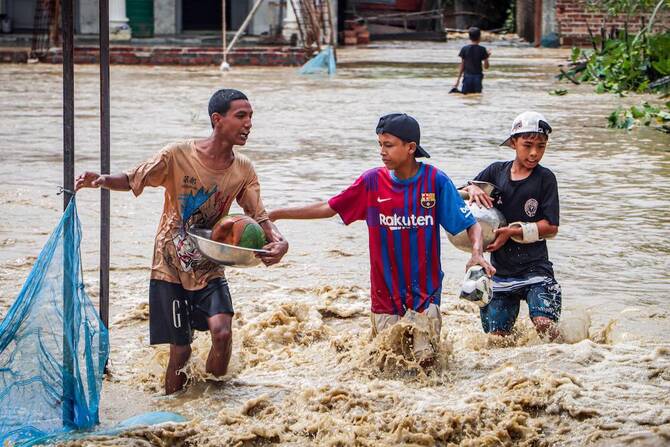
    Above, youngsters wade through a flooded street after heavy monsoon rain showers in India on Sept. 15, 2025. (AFP)
    Above, youngsters wade through a flooded street after heavy monsoon rain showers in India on Sept. 15, 2025. (AFP)

    HYDERABAD: India moved 50,000 people to relief camps on Monday as it began evacuations a day before Cyclone Montha, intensifying over the Bay of Bengal, is set to bring strong winds and heavy rains to its east coast, officials said.

    Authorities canceled holidays for emergency staff and ordered schools and colleges to close in coastal areas of the southern state of Andhra Pradesh and the eastern state of Odisha forecast to be hit by the harsh weather.

    The cyclone is likely to turn into a severe storm by Tuesday, before crossing the coast of Andhra Pradesh later in the day, the India Meteorological Department (IMD) said.

    “Evacuation of people from near the coast in Kakinada district has already started,” a disaster management official in Andhra Pradesh told Reuters.

    Nearly 50,000 people have been moved to relief camps, a government report showed.

    Disaster teams have fanned out to move families from low-lying areas in Andhra Pradesh, where the government expects 3.9 million people to be affected.

    Fishermen in the neighboring state of Odisha were warned to avoid venturing to sea.

    Cyclones frequently hit India’s east coast between April and December. A super cyclone that killed nearly 10,000 when it hit Odisha in October 1999 remains one of the country’s deadliest natural disasters.

    Authorities in the southern state of Tamil Nadu have urged people to keep alert following forecasts for heavy to very heavy rain in some districts.

    Chennai, the state capital, is prone to flooding during intense rains, such as those brought by Cyclone Michaung in 2023.

    In the Himalayan nation of Nepal, disaster authorities have warned of possible rain and snowfall from Tuesday through Friday and advised trekkers to keep alert.

    Floods and landslides triggered by heavy rains across Nepal killed 53 people this month.

  • India races to reform financial sector as foreigners pull $17 billion

    India races to reform financial sector as foreigners pull $17 billion

    A woman walks past the Securities and Exchange Board of India (SEBI) headquarters in Mumbai, India, September 12, 2025. Photo: REUTERS/Francis Mascarenhas/File Photo/File Photo
    A woman walks past the Securities and Exchange Board of India (SEBI) headquarters in Mumbai, India, September 12, 2025. Photo: REUTERS/Francis Mascarenhas/File Photo/File Photo

    New Delhi : Rattled by nearly $17 billion in foreign outflows this year, India is doubling down on financial sector reforms in a push to beef up capital buffers and lift investment in the country amid wider worries about the economic hit from US tariffs.

    Several measures to anchor foreign participation and boost credit have already been announced by the central bank and market regulator in recent months. These include quicker pathways for companies to list and foreign funds and overseas lenders to enter and rules that allow corporates to borrow more easily and banks to finance mergers.

    Other areas of regulatory easing in India’s $260 billion financial sector are under discussion to be rolled out over the next six-to-12 months, said six regulatory and market sources with knowledge of the matter.

    The possible changes include bolstering capital market participation by mom-and-pop investors in smaller towns and further easing banking regulations, said the sources.

    The dismantling of decades-old restrictions comes as Prime Minister Narendra Modi pushes for greater economic self-reliance after concerns about the hit to India’s growth from punitive US tariffs unnerved foreign investors.

    The sources declined to be named as they were not authorised to speak to the media.

    The central bank did not respond to a Reuters request for comment on new possible easing measures. A SEBI spokesperson, in response to Reuters queries, said it has introduced 11 “major reforms” for foreign investors to improve their access to India and enhance India’s global competitiveness.

    “There is an increased focus on ease of doing business and the regulatory cholesterol clogging up the financial sector is being cleared,” said Srini Srinivasan, managing director, Kotak Alternate Asset Managers, which manages $20 billion in assets.

    CREATING INVESTOR-FRIENDLY ENVIRONMENT

    Foreign investors have net sold nearly $17 billion in Indian equities this year, compared with $124 million in inflows in 2024 and $20 billion in 2023. The sell-off has made India the worst-hit Asian market in terms of foreign portfolio withdrawals.

    The gradual loosening in India coincides with the initiatives China has unveiled in recent months, including opening its stock option market to foreign investors and expanding foreign access to its bond repurchase market.

    India’s economy is seen growing 6.8% in the fiscal year to March 31, 2026, according to the Reserve Bank of India (RBI) estimates, compared to 6.5% in the previous year, but below the central bank’s “aspirational” growth of about 8%.

    The regulatory changes are intended to be pro-business and revive foreign investment and boost growth, the sources said.

    Vikas Pershad, a Singapore-based India portfolio manager in the Asia Pacific Equities team at M&G Investments, which manages $443 billion in client assets, said the regulatory easing and strong growth outlook are among reasons for investors to stay “constructive” on India.

    “This year’s concerted efforts to ease certain regulatory requirements … have certainly not gone unnoticed,” said Pershad.

    “As long-term investors in India, we believe these steps are meaningful in creating a more accessible and investor-friendly environment.”

    FRESH THINKING, CLOSER COORDINATION

    The shift comes less than a year after leadership changes at the RBI and SEBI.

    Sanjay Malhotra became RBI governor in December and Tuhin Kanta Pandey started as SEBI chief in March.

    Both previously worked together in the finance ministry and are focused on reversing years of tight regulation that followed a debt crisis between 2016 and 2018, analysts and insiders say.

    In internal meetings this year, Malhotra argued crisis-era rules remained in force long after the shock, likening them to a plaster left on after a fracture healed, according to one source.

    Under those changes, banks can now fund acquisitions and lend more against listed debt and equity securities, the central bank announced this month.

    Capital buffer requirements for non-bank lenders funding infrastructure have been eased and additional provisions on banks lending to large corporates have been removed.

    Long-standing rules limiting lower-rated borrowers from raising debt overseas have also been dismantled.

    “The current governor is leaning more towards liberalisation and optimum regulation. Some of these changes are really needed,” said HR Khan, former RBI deputy governor.

    SEBI’s focus includes simplifying foreign investor access and encouraging investment from smaller urban areas, two sources said.

    “Mutual funds have proven to be the right vehicle to get retail investors from smaller cities into capital markets,” a SEBI spokesperson said, adding that the regulator is increasing access for more such funds.

  • India’s largest hydropower project undergoes test run

    India’s largest hydropower project undergoes test run

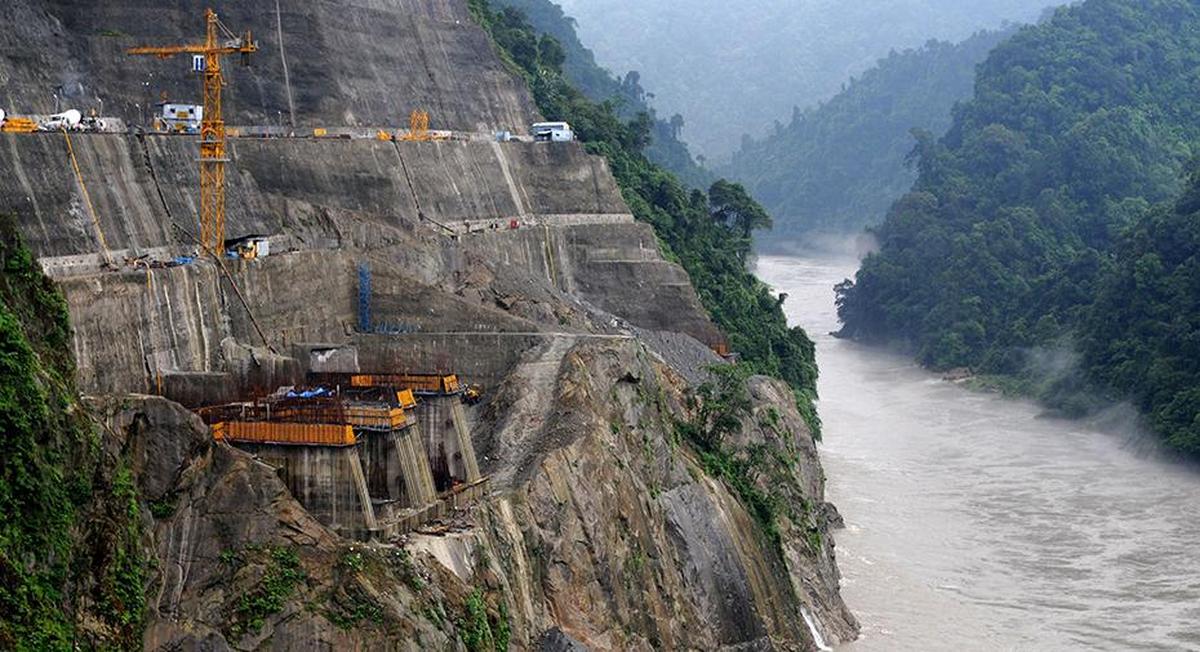
    File photo of the NHPC’s 2,000 MW Lower Subansiri project being constructed in Arunachal Pradesh. | Photo Credit: The Hindu
    File photo of the NHPC’s 2,000 MW Lower Subansiri project being constructed in Arunachal Pradesh. | Photo Credit: The Hindu

    Guwahati : One of the eight units of India’s largest hydropower project, which straddles the Arunachal Pradesh-Assam border, has begun undergoing a test run, signalling its commissioning soon.

    Officials of the NHPC Limited said the wet commissioning of the first 250 megawatt unit of the 2,000 MW Subansiri Lower Hydroelectric Project was commenced on Friday (October 24, 2025).

    “Wet commissioning is basically a test run of the turbine to check several parameters without generating electricity. The test run with water flow may take four to five days,” an NHPC spokesperson told The Hindu on Saturday (October 25).

    The Subansiri Lower project has eight units of 250 MW each. “Four of these units are ready for test runs. The next step involves synchronisation of at least two units for the project to start generating power,” he said.

    The Subansiri Lower project, located at Gerukamukh on the inter-State boundary, was launched in January 2005. Work on the project was suspended in 2011 following protests by anti-dam activists in Assam and concerns over downstream environmental impacts.

    The work resumed in October 2019 after the Prime Minister’s Office pushed for its completion, and the NHPC adopted enhanced mitigation and safety measures.

    NHPC Chairman and Managing Director Bhupender Gupta, who attended the wet commissioning event, stated that the achievement was a “shining testament” to the corporation’s engineering excellence. “It is more than just a project milestone; it reflects India’s steady march toward a cleaner, greener, and self-reliant energy future,” he said.

  • ‘No Benefit In Fighting India’: Ex-CIA Officer Who Led Pak Operations

    ‘No Benefit In Fighting India’: Ex-CIA Officer Who Led Pak Operations

    John Kiriakou, who has served in the CIA for 15 years, has opened up about his years leading counterterrorism operations in Pakistan.
    John Kiriakou, who has served in the CIA for 15 years, has opened up about his years leading counterterrorism operations in Pakistan.

    New Delhi: Pakistan would lose any conventional war with India, a former US intelligence officer has said, recalling that the Central Intelligence Agency (CIA) believed the two nuclear-armed nations would go to war after the 2001 Parliament attacks. John Kiriakou, who has served in the CIA for 15 years, opened up about the unease between Washington and Islamabad and his years leading counterterrorism operations in Pakistan during an interview with news agency ANI.

    Islamabad needs to arrive at a policy conclusion that it would gain nothing from a war with India, the former CIA officer noted. “Nothing, literally nothing good will come of an actual war between India and Pakistan because the Pakistanis will lose. I’m not talking about nuclear weapons. I’m talking just about a conventional war. There is no benefit to constantly provoking Indians,” he added.

    India had acted decisively after attacks carried out by terrorists from across the border over the years, including surgical strikes in 2016, Balakot strikes in 2019, and Operation Sindoor after the Pahalgam attack that left 26 innocents dead in April this year.

    New Delhi also warned Islamabad that it will not tolerate its nuclear blackmail, as the Pakistanis tried to control the rhetoric despite pleading for a ceasefire after failed attempts to target Indian cities.

    Kiriakou shared that in 2002, the US anticipated that India-Pakistan tensions at the height of Operation Parakram, after the 2001 Parliament attack, could escalate to a war and had started evacuating its civilians from Islamabad. He also claimed that during his Islamabad stint, he was unofficially told that the Pentagon controlled Pakistan’s nuclear arsenal. “Musharraf had turned control over to the US.”

    At that time, the CIA was focused on Al Qaeda and Afghanistan and did not pay much attention to India’s concerns, the former CIA officer admitted.

    ‘US Could Have Killed Pak Scientist’

    The US could have eliminated Abdul Qadeer Khan, who designed Pakistan’s atomic bomb, but spared him at the request of Saudi Arabia, Kiriakou said.

    “If we had taken the Israeli approach, we would have just killed him. We knew where he lived and spent his day. But he had the support of the Saudi government. The Saudis came to us and said, ‘Please leave him alone. We like AQ Khan. We’re working with AQ Khan. Just leave him alone,” he recounted.

    Kiriakou had turned a whistleblower in 2007 and exposed the CIA’s “torture programme” in a television interview. He spent 23 months in jail. The charges against him were later dropped, with the former CIA officer remarking that he has “no regrets, no remorse.”

  • After India, Taliban-Ruled Afghanistan Moves To Curb River Water Flow To Pakistan

    After India, Taliban-Ruled Afghanistan Moves To Curb River Water Flow To Pakistan

    Afghanistan’s decision mirrors India’s recent move to suspend the Indus Waters Treaty after Pakistan-backed terrorists killed 26 civilians in Pahalgam on April 22. The treaty had allowed Pakistan access to water from three western rivers — the Indus, Jhelum, and Chenab.
    Afghanistan’s decision mirrors India’s recent move to suspend the Indus Waters Treaty after Pakistan-backed terrorists killed 26 civilians in Pahalgam on April 22. The treaty had allowed Pakistan access to water from three western rivers — the Indus, Jhelum, and Chenab.

    Kabul :Taliban-ruled Afghanistan has announced plans to construct dams and restrict the flow of river water to Pakistan, the Afghan Information Ministry said on Thursday. The directive to expedite dam construction on the River Kunar was issued by Taliban Supreme Leader Mawlawi Hibatullah Akhundzada, underscoring the regime’s growing emphasis on asserting control over transboundary water resources.

    According to the ministry, Akhundzada instructed the Ministry of Water and Energy to commence work on the project immediately and sign contracts with domestic firms. “The Supreme Leader has ordered the ministry to sign contracts with Afghan companies rather than wait for foreign firms,” Deputy Information Minister Muhajer Farahi posted on X.

    Move Comes After India Suspended Water-Sharing With Pakistan
    Afghanistan’s decision mirrors India’s recent move to suspend the Indus Waters Treaty after Pakistan-backed terrorists killed 26 civilians in Pahalgam on April 22. The treaty had allowed Pakistan access to water from three western rivers — the Indus, Jhelum, and Chenab.

    London-based Afghan journalist Sami Yousafzai wrote on X, “After India, it may now be Afghanistan’s turn to restrict Pakistan’s water supply,” adding that the Taliban’s order underscores a broader regional assertion over water rights.

    Strategic Importance Of The Kunar and Kabul Rivers
    The 480-km-long Kunar River originates in the Hindu Kush mountains near the Broghil Pass, close to the Pakistan border. It flows southward through Afghanistan’s Kunar and Nangarhar provinces before entering Pakistan’s Khyber Pakhtunkhwa, where it joins the Kabul River near Jalalabad. Known as the Chitral River in Pakistan, it plays a vital role in feeding the Kabul River, which in turn merges with the Indus near Attock.

    Any reduction in Kunar’s flow would therefore have a cascading impact on the Indus River system, threatening irrigation and water supply in Pakistan’s Khyber Pakhtunkhwa and Punjab provinces.

    Tensions Along The Durand Line
    The Taliban’s move comes weeks after deadly clashes along the Durand Line, which is the de facto border between Afghanistan and Pakistan, is not recognized by Kabul. Drawn during the colonial era, the Durand Line split the Pashtun heartland between the two nations and remains a major source of tension.

    Since returning to power in 2021, the Taliban has prioritised water sovereignty as a cornerstone of national policy. It has accelerated dam-building and hydropower initiatives to harness domestic river systems for irrigation, electricity generation, and reduced reliance on neighbouring countries.

    Pakistan and Afghanistan, however, lack a formal water-sharing agreement. Islamabad has repeatedly warned that Kabul’s unilateral steps could heighten regional instability and exacerbate Pakistan’s ongoing food and energy crises.

    India-Afghanistan Strengthen Hydropower Cooperation
    Afghanistan’s decision comes shortly after Taliban Foreign Minister Mawlawi Amir Khan Muttaqi’s visit to India, where he met External Affairs Minister S. Jaishankar. Both sides reaffirmed their commitment to hydropower cooperation.

    “Appreciating India’s assistance in the construction and maintenance of the India-Afghanistan Friendship Dam (Salma Dam) in Herat, both sides also underscored the importance of sustainable water management,” the joint statement read. They agreed to collaborate on hydroelectric projects to support Afghanistan’s energy and agricultural needs.

    Legacy Of India-Afghanistan Water Projects
    India’s long-standing partnership with Afghanistan in the water and energy sectors includes the Salma Dam, completed in 2016 with $300 million in Indian funding. The project generates 42 MW of power and irrigates 75,000 hectares, significantly cutting Afghanistan’s dependence on imported electricity.

    In 2021, both nations signed an MoU for the Shahtoot Dam on the Maidan River — a tributary of the Kabul River — with India committing $250 million to store 147 million cubic metres of water. The dam aims to provide clean water to over two million Kabul residents and irrigate 4,000 hectares of farmland.

  • Starlink to establish nine gateway stations across India ahead of satellite services launch

    Starlink to establish nine gateway stations across India ahead of satellite services launch

    New Delhi: SpaceX’s satellite internet service, Starlink, plans to set up nine gateway earth stations in major Indian cities, including Mumbai, Noida, Chandigarh, Hyderabad, Kolkata, and Lucknow, according to a report by The Economic Times. These stations will help prepare for the launch of Starlink’s satellite internet services in India.

    An official told The Economic Times that the company has applied for 600 gigabit per second capacity over India through its Gen 1 satellite constellation, and that the spectrum has been provisionally assigned to demonstrate security-related compliances.

    Security concerns

    The Elon Musk-owned company has been given temporary permission to use some radio spectrum to test its systems and meet security requirements. It has also been allowed to import 100 satellite terminals for testing, but not for commercial use yet.

    Given that satcom can be sensitive for national security, the government has set strict rules. Starlink must ensure that:

    Only Indian nationals operate the ground stations until foreign staff get security clearance.

    Data from the tests stays within India.

    Details of all equipment used are shared regularly with the authorities.

    Starlink is the third company, after OneWeb and Jio Satellite, to get permission for such security tests. None of them can start full operations until security agencies approve.

    Illegal Starlink devices in India

    Earlier this year, authorities found illegal Starlink devices being used in border areas like Manipur and the Andaman and Nicobar Islands, which raised security concerns. However, Musk rejected the claims of Starlink devices being used in Manipur. He said in a post on X, “This is false. Starlink satellite beams are turned off over India.”

    Starlink is gearing up for a late 2025 or early 2026 launch in India after obtaining key government approvals.

  • India Appoints New Chargé d’Affaires in Kabul Following Diplomatic Upgrade

    India Appoints New Chargé d’Affaires in Kabul Following Diplomatic Upgrade

    Karan Yadav, who previously headed India’s technical mission in Kabul, has now been appointed as the chargé d’affaires at the Indian Embassy in Kabul.
    Karan Yadav, who previously headed India’s technical mission in Kabul, has now been appointed as the chargé d’affaires at the Indian Embassy in Kabul.

    Kabul : Following the upgrade of diplomatic relations between India and Afghanistan, Indian media outlets reported that India has appointed a new chargé d’affaires for its embassy in Afghanistan after four years.

    According to reports, Karan Yadav, who previously headed India’s technical mission in Kabul, has now been appointed as the chargé d’affaires at the Indian Embassy in Kabul.

    Moeen Gul Samkanai, a political analyst, stated: “India is one of the regional superpowers and a member of organizations such as BRICS and the Shanghai Cooperation Organization. Therefore, we must maintain regional and international relations with them.”

    The appointment of India’s chargé d’affaires to Afghanistan comes a day after the spokesperson of the Islamic Emirate of Afghanistan also described the strengthening of diplomatic relations with India as a sign of growing diplomatic engagement between the two countries.

    Mohammad Ebrahim Fekrat Asadi, another political analyst, commented: “The recent tensions between Afghanistan and Pakistan prompted India to elevate its relations with Afghanistan, which also benefits India.”

    Although over the past four years, relations between India and the Islamic Emirate of Afghanistan have been minimal, the recent visit of Amir Khan Muttaqi, the Islamic Emirate of Afghanistan’s foreign minister, to New Delhi appears to have opened the door for expanding ties with India.

  • India’s next CJI calls for India-Sri Lanka collaboration to protect Indian ocean

    India’s next CJI calls for India-Sri Lanka collaboration to protect Indian ocean

    Supreme Court judge Justice Surya Kant, who is slated to be the next Chief Justice of India | ANI file photo
    Supreme Court judge Justice Surya Kant, who is slated to be the next Chief Justice of India | ANI file photo

    New Delhi : India’s next Chief Justice of India (CJI), Justice Surya Kant, has called for strengthened collaboration between India and Sri Lanka to safeguard the Indian Ocean, emphasising that environmental cooperation is not a matter of charity or diplomacy but a necessity for survival.

    Addressing an event at the University of Colombo during his three-day visit to Sri Lanka, Justice Kant highlighted the historical significance of the seas between India and Sri Lanka, noting that they were once arteries of exchange—carrying faith, culture, and ideas.

    “The time has come for India and Sri Lanka to pioneer a regional model of environmental constitutionalism,” he said, urging both nations to lead by example in protecting the marine ecosystem.

    Justice Kant also announced that a delegation of Sri Lankan Supreme Court judges would visit India later this year or in early 2026, describing the initiative as a step to strengthen judicial dialogue and institutional collaboration between the two countries.

    Highlighting the ecological interdependence of India and Sri Lanka, Justice Kant described the Indian Ocean as a historic bridge connecting the peoples of both nations through culture, faith, and shared ecosystems.

    He warned that “beneath the calm turquoise waters of the Palk Strait lie signs of ecological vulnerability—oil spills drifting across shores, coral reefs bleaching under shared warming currents, and fishing communities whose livelihoods hinge on decisions taken in two capitals.”

    He highlighted how the Palk Bay and Gulf of Mannar, once biodiversity hotspots, are now under severe stress from overfishing, destructive trawling, and unregulated coastal activity. The recurring confrontations between Indian trawlers and Sri Lankan fishers, he said, “epitomise a deeper ecological tragedy—competition for an exhausted resource base.”

    Justice Kant also highlighted the impacts of climate change, such as saltwater intrusion, microplastic buildup, and uncoordinated disaster responses, urging both nations to engage in joint monitoring and data sharing.

    Describing the judiciary as a “moral and constitutional guardian” of ecological balance, Justice Kant underscored that both India and Sri Lanka have advanced robust environmental jurisprudence.