Tag: Rohingya

  • Rohingya conference: US, UK announce fresh aid commitment of $96m

    Rohingya conference: US, UK announce fresh aid commitment of $96m

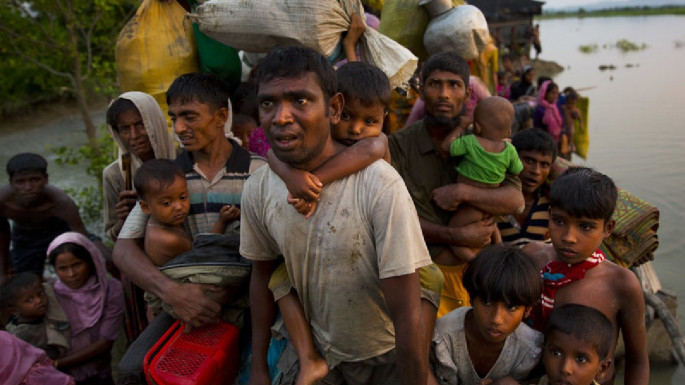
    Representational image of Rohingya refugees/Collected
    Representational image of Rohingya refugees/Collected

    Dhaka : The United States and the United Kingdom announced fresh aid commitment of $96 million in the first ever high-level conference on the Rohingya and other Myanmar minorities at the UN headquarters yesterday (30 September), said Chief Adviser’s Press Secretary Shafiqul Alam.

    The US announced a new donation of $60 million and the UK $36 million, he told UNB.

    “Houses burned. Neighbours killed. Hope vanishing.” With those stark words, General Assembly President Annalena Baerbock opened the high-level UN conference, as alarm rises over the impact of Myanmar’s deepening crisis which threatens to destabilise the wider region.

    Assembly President Baerbock underscored the scale of suffering.

    “Over five million Rohingya men, women and children share some version of this story,” she said, noting that 800,000 children remain out of school in Bangladesh’s Cox’s Bazar camp alone.

    Humanitarian funding is critically short, with the 2025 response plan just 12% funded.

    “This should put us to shame,” she declared, urging states to boost aid and pursue a political solution that would enable safe, voluntary and sustainable return.

    At the heart of the emergency are the Rohingya Muslims, denied Burmese citizenship, driven from their homes and forced into camps or exile, according to the UN news.

    More than a million now live as refugees in Bangladesh, while countless more remain displaced or trapped – alongside other minorities – inside Myanmar under conditions UN leaders described as “dire” and “unsustainable.”

    The conference at UN Headquarters in New York, brought together top UN officials, heads of state and governments, to galvanise action alongside Rohingya activists.

    Briefings and reports laid bare the daily realities since the February 2021 military coup: forced recruitment, sexual violence, airstrikes, starvation and mass displacement.

    Humanitarian agencies warn that resources are running out, leaving refugees malnourished and pushing more people into taking dangerous sea journeys.

    Conditions inside Myanmar’s Rakhine state – ancestral home of the Rohingya – are described as the worst in decades, with civilians caught between junta forces and ethnic armed groups.

    ‘Human Rights Trampled’

    The secretary-general, in a statement read by his Chef de Cabinet Courtenay Rattray, said the crisis has “trampled on the human rights, dignity and safety of millions and threatens regional stability.”

    He urged three immediate steps: protecting civilians in line with international law, guaranteeing humanitarian access, and reinvigorating investment to ease the strain on refugees and host communities.

    “The solution to this crisis lies ultimately in Myanmar,” the message stressed, calling for an end to persecution and recognition that “the Rohingya belong – as full citizens.”

    Humanitarian funding is critically short, with the 2025 response plan just 12% funded.

    “This should put us to shame,” she declared, urging states to boost aid and pursue a political solution that would enable safe, voluntary and sustainable return.

    Demand for Accountability

    For Rohingya activists, the conference was not another moment of awareness but a demand for justice.

    Wai Wai Nu, founder of the Myanmar Women’s Peace Network, told delegates that the atrocities did not end in 2017, when over 750,000 Rohingya men, women and children fled violence described as a “textbook example of ethnic cleansing” by then UN High Commissioner for Human Rights, Zeid Ra’ad Al Hussein.

    “It has worsened,” she said, pointing to killings, forced conscription, sexual violence and starvation inflicted by both the Myanmar military and ethnic armed groups fighting the junta.

    “Without action, the Rohingya exodus will continue until there is no more Rohingya left in Myanmar,” she warned, urging cross-border humanitarian corridors, targeted sanctions and prosecutions for atrocity crimes.

    ‘A test for humanity’

    Rofik Husson, founder of the Arakan Youth Peace Network, offered his own testimony of displacement and violence, recalling how the junta forced Rohingya men and boys into service, often as human shields. In one week alone, he said, at least 400 were killed.

    He described village burnings and drone strikes, including a May 2024 massacre that displaced 200,000 people in a single day.

    “Ending the crisis of insecurity for the Rohingya community is a test for this Assembly and a test for humanity itself,” he told delegates, calling for an internationally supervised safe zone in northern Rakhine.

    No Agreed Pathway to Peace

    Adding a wider lens, Special Envoy Julie Bishop stressed that Myanmar’s multifaceted crisis is inseparable from the political turmoil unleashed by the 2021 coup.

    With no ceasefire in place and armed conflict spreading, she warned that planned elections later this year would fuel further violence rather than deliver legitimacy.

    “There is no agreed pathway to peace,” she said, cautioning that international condemnation of the junta has ebbed even as abuses persist.

    A Fragile Hope

    Despite the grim accounts, speakers emphasised that solutions remain possible if political will can be summoned.

    Baerbock closed her remarks by noting, “The Rohingya people have survived eight years of hardship, displacement and uncertainty. Their resilience is extraordinary. Our response must match it.”

    For Rohingya activists, the message was equally clear: declarations are no longer enough.

    “Justice is not optional…It is the only deterrent, the only path to peace,” Nu said.

  • Rohingyas seek clear repatriation roadmap from upcoming UN talks in NY

    Rohingyas seek clear repatriation roadmap from upcoming UN talks in NY

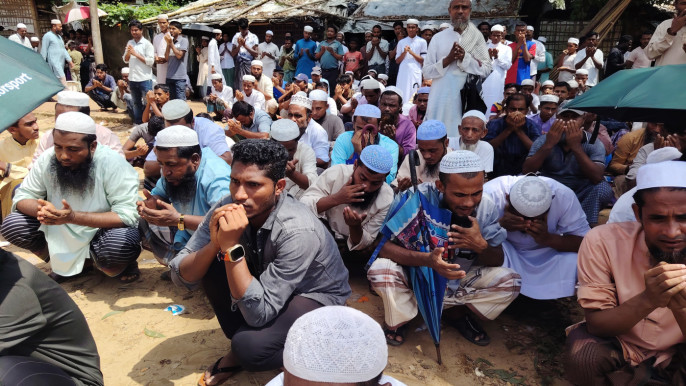
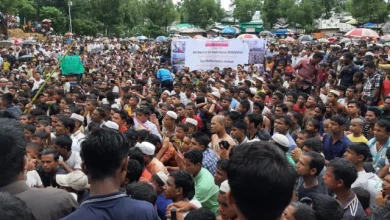
    Rohingya refugees in Bangladesh urged the UN and international community to take effective measures to ensure justice for the genocide they endured at the assembly. Photo: TBS
    Rohingya refugees in Bangladesh urged the UN and international community to take effective measures to ensure justice for the genocide they endured at the assembly. Photo: TBS

    New York : Rohingya refugees in Bangladesh have called on the United Nations and the international community to present a “concrete” roadmap for solving the crisis, ahead of a UN-led international conference on the issue scheduled for 30 September in New York.

    Voicing the demand at a rally organised by a group called “Rohingya Elected Civil Society” this morning (27 September) at Camp 13 in Thaingkhali, located in Ukhiya Upazila of Cox’s Bazar, they also appealed for global cooperation to ensure their safe and dignified return to their homeland in Myanmar.

    At the assembly, the Rohingya refugees urged the UN and international community to take effective measures to ensure justice for the genocide they endured.

    They also expressed their deep gratitude to the government of Bangladesh and locals for providing them with shelter for more than eight years.

    They said they hope that the upcoming conference will guide the global community towards a permanent and lasting solution to their long-standing problem.

    Currently, over 1.3 million Rohingya refugees are living in Bangladesh, the majority of whom fled ethnic violence in Myanmar’s Rakhine State on 25 August 2017.

    On 21 August this year, Chief Adviser Muhammad Yunus expressed hope that the UN conference in New York will provide concrete pathways to the resolution of the prolonged Rohingya crisis.

    He requested Tom Andrews, special rapporteur on the situation of human rights in Myanmar, to continue his efforts in ensuring the availability of adequate funding, as the recent cut in financial support to the Rohingyas sheltered in Bangladesh is taking its toll on the provision of essential services, including health and education.

    Additionally, Chief Adviser’s Press Secretary Shafiqul Alam, on numerous occasions, has said the interim government is actively engaging with international stakeholders to address the Rohingya crisis, bringing the issue back to global forums as a major topic of discussion and working towards a roadmap for the safe and dignified return of Rohingyas to Myanmar.

  • Intl. community to stand by Bangladesh in resolving the Rohingya crisis

    Intl. community to stand by Bangladesh in resolving the Rohingya crisis

    Bangladesh also emphasized the need for concrete and time-bound outcomes from the upcoming High-Level Conference on the Rohingya issue
    Bangladesh also emphasized the need for concrete and time-bound outcomes from the upcoming High-Level Conference on the Rohingya issue

    Dhaka : In view of the complexities surrounding the Rohingya crisis, the international community has pledged to continue working with the Bangladesh government to maintain focus on the situation in Myanmar and the ongoing humanitarian emergency in Bangladesh.

    In particular, ahead of the upcoming high-level conference in New York next month, Bangladesh and the international community will work in close cooperation.

    Marking eight years since the mass influx of Rohingya from Myanmar’s Rakhine State into Bangladesh, eleven Western nations have reaffirmed their commitment to stand by Bangladesh. Australia, Italy, the United Kingdom, Canada, the Netherlands, Norway, Denmark, Sweden, France, Switzerland and Finland expressed this pledge in a joint statement.

    On Monday morning, the embassy of France in Dhaka released the joint statement through its official X handle and Facebook page.

    The statement by the 11 nations said, “Eight years on, we recall the actions of the Myanmar military which led to the displacement of a vast number of Rohingya people. Currently, over 1.1 million (11 lakh) Rohingya remain in Bangladesh, with new arrivals continuing to seek refuge in camps.”

    The statement further stated, “We commend the resilience and fortitude of the Rohingya, who have endured prolonged hardship and displacement. Their perseverance is especially notable in the face of the deteriorating security and humanitarian situation in Rakhine State.”

    The 11 nations statements declared, “We extend our deep appreciation to the interim Government of Bangladesh and to the Bangladeshi people for providing shelter, safety and lifesaving humanitarian assistance to the Rohingya, including those newly arrived.”

    The statement emphasised that Rohingya refugees in Bangladesh wish to return to their homeland. It reiterated that the international community remains committed to exploring viable pathways for repatriation.

    However, cross-border displacement continues and many Rohingya remain internally displaced within Rakhine. Presently, conditions in Myanmar do not allow for their voluntary, safe, dignified and sustainable return.

    In the joint statement, the 11 nations affirmed, “Addressing the root causes of displacement is essential, requiring a peaceful and stable Myanmar. Therefore, we acknowledge that it is not yet possible to set a definitive timeframe for Rohingya repatriation. We urgently call on all parties to take immediate steps towards creating a possible environment for return.”

    The 11 nations further stated, “We strongly condemn the violence and human rights violations committed by the Myanmar military and other armed groups. We once again call for an end to violence and for unimpeded humanitarian access. We also reiterate the demand for the release of those unjustly detained. We remain committed to supporting international efforts to ensure accountability for breaches of international humanitarian law and other grave violations of human rights.”

    The countries that gave joint statement declared, “We support more durable solutions for Rohingya refugees through strengthened self-reliance. In particular, as humanitarian funding for the crisis diminishes, we stress the importance of preparing them for eventual repatriation. We also reaffirm our support for the host communities in Cox’s Bazar, who have generously extended hospitality to the refugees.”

    The countries in the statement stated, “We underline the importance of ensuring meaningful participation and inclusive representation of the Rohingya, so that they are empowered in decision-making and able to lead safe, dignified and constructive lives while in Bangladesh. Eight years on, the international community stands steadfastly with the Rohingya and Bangladesh in seeking long-term and sustainable solutions. We remain committed to addressing the root causes of this crisis.”

  • Support for Rohingya refugees in Bangladesh risks collapse: UN refugee agency

    Support for Rohingya refugees in Bangladesh risks collapse: UN refugee agency

    Rohingya refugee returns must meet international standards -UNHCR
    Rohingya refugee returns must meet international standards -UNHCR

    Dhaka : Essential services for the Rohingya refugee population in Bangladesh are at risk of collapsing unless more money is found, the United Nations refugee agency said on Friday, with its appeal for $255 million to support them just 35% funded.

    More than 1 million Rohingya have been crammed into the camps in southeastern Bangladesh, the world’s largest refugee settlement. Most fled a brutal crackdown by Myanmar’s military in 2017, although some have been there for longer.

    “There is a huge gap in terms of what we need and what resources are available. These funding gaps will affect the daily living of Rohingya refugees as they depend on humanitarian support on a daily basis for food, health and education,” United Nations High Commissioner for Refugees spokesperson Babar Baloch told reporters in Geneva.

    The humanitarian sector has been roiled by funding reductions from major donors, led by the US under President Donald Trump and other Western countries, as they prioritise defence spending prompted by growing fears of Russia and China.

    “With the acute global funding crisis, the critical needs of both newly arrived refugees and those already present will be unmet, and essential services for the whole Rohingya refugee population are at risk of collapsing unless additional funds are secured,” Baloch said.

    Health services would be severely disrupted by September, and by December essential food assistance would stop, UNHCR said.

    At least 150,000 Rohingya refugees have arrived in Cox’s Bazar in Bangladesh in the last 18 months, according to UNHCR.

    Violence and persecution against the Rohingya, a mostly Muslim minority in mainly Buddhist Myanmar’s western Rakhine state, have continued to force thousands to seek protection across the border in Bangladesh, it added.

    “This movement of Rohingya refugees into Bangladesh… is the largest from Myanmar into Bangladesh since 2017 when some 750,000 Rohingya fled the deadly violence in their native Rakhine state in Myanmar,” Baloch stated.

  • Rohingya refugees increasingly risk perilous journeys to safety, 427 dead this month: UN

    Rohingya refugees increasingly risk perilous journeys to safety, 427 dead this month: UN

    Rohingya refugees hold placards while attending a Ramadan Solidarity Iftar to have an Iftar meal with United Nations Secretary-General Antonio Guterres and Muhammad Yunus, Chief Adviser of Bangladesh Interim Government, at the Rohingya refugee camp in Cox's Bazar, Bangladesh, March 14, 2025. Photo: REUTERS/Mohammad Ponir Hossain/File Photo
    Rohingya refugees hold placards while attending a Ramadan Solidarity Iftar to have an Iftar meal with United Nations Secretary-General Antonio Guterres and Muhammad Yunus, Chief Adviser of Bangladesh Interim Government, at the Rohingya refugee camp in Cox’s Bazar, Bangladesh, March 14, 2025. Photo: REUTERS/Mohammad Ponir Hossain/File Photo

    Dhaka: Dire humanitarian conditions in Myanmar and Bangladesh are driving more Rohingya to risk dangerous boat journeys to safety, such as one this month that ended in a sinking and estimates of 427 deaths, the UN refugee agency said on Friday.

    The minority community’s plight might have been worsened by aid funding cuts, the agency added.

    The humanitarian sector has been roiled by funding reductions from major donors, led by the US under President Donald Trump, and other Western countries as they prioritise defence spending prompted by growing fears of Russia and China.

    Two boats carrying some 514 Rohingya sank on May 9 and 10, carrying refugees who were thought to have left from refugee camps in Cox’s Bazar, Bangladesh, and Rakhine State in Myanmar.

    Only 87 survivors were found, UNHCR said. The possible deaths of 427 people would make it the deadliest tragedy at sea involving Rohingya refugees so far this year, according to the agency.

    That people chose to board boats during the annual monsoon season, which brings dangers such as strong winds and rough seas, reflected their desperation, the agency added.

    “The dire humanitarian situation, exacerbated by funding cuts, is having a devastating impact on the lives of Rohingya, with more and more resorting to dangerous journeys to seek safety, protection and a dignified life for themselves and their families,” said Hai Kyung Jun, Director of UNHCR’s Regional Bureau for Asia and the Pacific.

    “The latest tragedy is a chilling reminder that access to meaningful protection, especially in countries of first asylum, as well as responsibility sharing and collective efforts along sea routes, are essential to saving lives,” Kyung Jun added.

    The agency urged more financial support to stabilise the lives of Rohingya refugees in host countries, including Bangladesh, and those displaced inside Myanmar. Its request for $383.1 million for support in 2025 is currently only 30 per cent funded, it said.

    UNHCR received over $2 billion in donations from the United States in 2024, or 40% of its total donations.

    A UNHCR spokesperson said that in March, it had frozen more than $300 million of planned activities as part of cost-saving measures.

  • UN urges more int’l focus on Rohingya refugees amid fund crunch

    UN urges more int’l focus on Rohingya refugees amid fund crunch

    The United Nations food agency said Monday lack of funding has forced it to cut food aid for around one million Rohingya refugees living in camps in Bangladesh for the second time in three months.
    The United Nations food agency said Monday lack of funding has forced it to cut food aid for around one million Rohingya refugees living in camps in Bangladesh for the second time in three months.

    The United Nations refugee agency on Tuesday urged the international community to keep focus on the plight of the Rohingya refugees amid a funding crunch and the lack of long-term solution for their safe return to Myanmar.

    Nearly one million Rohingya Muslims fled a military-led crackdown in Buddhist-majority Myanmar in 2017 and are now living in camps in Bangladesh in what U.N. High Commissioner for Refugees Filippo Grandi described as “the biggest humanitarian refugee camp in the world”.

    The UN has managed to secure only 42% of the $875.9 million needed for the Rohingya refugee this year which makes short term support for the refugee population in the camps difficult, Grandi told Reuters in an interview.

    “This decline in humanitarian assistance makes it more difficult to continuously, for example, renew the shelters,” Grandi said.

    “You have to invest money all the time and that money is becoming short, so conditions are now beginning to regress,” he said.

    Grandi was in Bangkok on Tuesday to host a meeting with high level officials in the region on the Rohingya issue, seeking pledges and support from governments and the private sector ahead of the Global Refugee Forum in December.

    Grandi praised Bangladesh for “miraculous” works in maintaining the Rohingya camps, allowing education for the Rohingya children, and said that the United Nations is currently discussing with Bangladesh on allowing refugees to work to support their livelihood in the camps.

    Improvements to the humanitarian situation in Myanmar, particularly on improving relations between Buddhist and Muslim communities and economic development, are essential to ensure a safe return for the Rohingya to their home, Grandi said.

    Myanmar has been under military rule since a 2021 coup and the junta have shown little inclination to take back any Rohingya, who have for years been regarded as foreign interlopers in Myanmar, denied citizenship and subjected to abuse.

    The Myanmar coup has also triggered conflict with a resistance movement and armed ethnic groups across the country, displacing more than a million people, the U.N. said.

    Myanmar junta spokesman did not answer calls from Reuters seeking comment.

    UNHCR high commissioner said Myanmar’s neighbouring countries can do more to press the military government on humanitarian concerns.

    “They are the best place to pass messages and to ensure that the humanitarian concerns are heard,” he said.

    “People are suffering in Myanmar a lot, not just the Rohingya, and they deserve a better future.”

  • US, Bangladesh want free, fair elections: US Deputy Assistant Secretary Afreen Akhter

    US, Bangladesh want free, fair elections: US Deputy Assistant Secretary Afreen Akhter

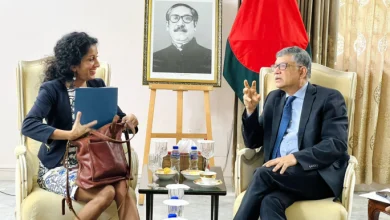
    Photo was taken from the facebook page of US Embassy in Dhaka
    Photo was taken from the facebook page of US Embassy in Dhaka

    Dhaka: The United States reaffirmed its wish for free and fair and peaceful elections in Bangladesh, said US Deputy Assistant Secretary Afreen Akhter today.

    The US deputy assistant secretary at the Bureau of South and Central Asian Affairs arrived in Dhaka today and held a meeting with Foreign Secretary Masud Bin Momen to discuss issues of mutual interest, including elections.

    “We discussed our strong multifaceted bilateral relationship and its many aspects: US direct investment and trade, our longstanding development partnership, the Middle East, the recent visit of the independent and non-partisan election survey team, supporting Rohingya refugees and government efforts to ensure the people of Bangladesh cast their votes in free, fair and peaceful elections,” the US Embassy in Dhaka said in a Facebook post after the meeting on Monday.

    Afreen Akhter also discussed the Rohingya crisis and might also visit Cox’s Bazar Rohingya camps during the visit.

    The US deputy assistant secretary looks after issues in Nepal, Sri Lanka, Bangladesh, Bhutan, and the Maldives, as well as the Office of Security and Transnational Affairs.

    She was the National Security and Foreign Affairs Adviser to US Senator Chris Van Hollen.

    Afreen Akhter earlier visited Dhaka in May this year.

  • Protests in Bangladesh camps mark six years of Rohingya exodus from Myanmar

    Protests in Bangladesh camps mark six years of Rohingya exodus from Myanmar

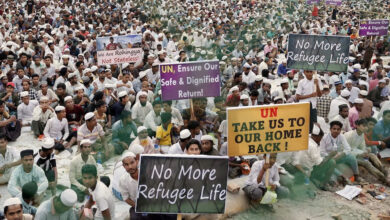
    The Rohingyas hold a peaceful rally demanding justice for the genocide in Myanmar in 2017 and five-point demands including dignified repatriation with full civil rights in their own homes in Cox’s Bazar on Friday, August 25, 2023. Photo: Dhaka Tribune
    The Rohingyas hold a peaceful rally demanding justice for the genocide in Myanmar in 2017 and five-point demands including dignified repatriation with full civil rights in their own homes in Cox’s Bazar on Friday, August 25, 2023. Photo: Dhaka Tribune

    Cox’sbazar: Thousands of Rohingya refugees rallied at camps in Bangladesh to demand their safe return to Myanmar on the sixth anniversary of the violence that drove them from their homes.

    Bangladesh is home to around a million members of the stateless minority, most of whom fled the 2017 military crackdown now subject to a genocide probe at the International Criminal Court.

    About 730,000 fled Myanmar following the 2017 crackdown and living in different countries in refugee camps.

    Frustration is widespread over rampant lawlessness in the refugee settlements, along with cuts to international humanitarian aid and the lack of progress in a much-hyped repatriation deal.

    “We demand citizenship back from Myanmar. It’s nothing new, we were and are the citizens of Myanmar,” Kamal Hussain, a Rohingya community leader, told the AFP news agency on Friday.

    “They are slowly trying to wipe out our name from the history of Myanmar.”

    Several protests were staged across the sprawling patchwork of settlements near the Myanmar border despite monsoon downpours.

    Around 10,000 refugees were present at the largest one, according to the Armed Police Battalion, which is tasked with maintaining security in the camps.

    “We have insecurity and increasing frustration here,” refugee Mohammad Imran, 19, said. “We want to go back home with our full rights.”

    The Rohingyas hold a peaceful rally demanding justice for the genocide in Myanmar in 2017 and five-point demands including dignified repatriation with full civil rights in their own homes in Cox’s Bazar on Friday, August 25, 2023.
    The Rohingyas hold a peaceful rally demanding justice for the genocide in Myanmar in 2017 and five-point demands including dignified repatriation with full civil rights in their own homes in Cox’s Bazar on Friday, August 25, 2023.

    Deepening hardships

    Budget cuts forced the UN World Food Programme to steeply reduce humanitarian aid to the Rohingya camps this year, with rations now $8 per refugee, per month.

    Malnutrition was already rampant among the refugee population and rights groups say the cuts have deepened existing hardships.

    Violence has continued to plague the camps, which are home to armed groups and are used as staging posts for regional drug trafficking networks.

    Dozens have been killed in Rohingya camp clashes so far this year, including women and children.

    “As humanitarian conditions in the world’s largest refugee settlement worsen… the challenges surrounding this protracted crisis continue to increase,” the UN refugee agency said in a statement this week.

    Bangladesh and Myanmar are working on a pilot programme to begin returning the Rohingya to their homes, despite concerns from rights groups who say conditions are not safe for their return.

    Widely viewed as interlopers from Bangladesh, Rohingya who remain in Myanmar are denied citizenship and access to healthcare, and require permission to travel outside of their townships.

    Myanmar junta chief Min Aung Hlaing — who was head of the army during the crackdown — has dismissed the term Rohingya as “imaginary”.

    Bangladesh has repeatedly said any repatriation would be voluntary.

    The pilot scheme has not begun, and Bangladesh refugee commissioner Mizanur Rahman told AFP his country was still working out details with Myanmar authorities.

    Source: TRT

  • Unpacking Burma’s Strategic Significance: Conflicts, Challenges, and Geopolitical Interests

    Unpacking Burma’s Strategic Significance: Conflicts, Challenges, and Geopolitical Interests

    Burma’s abundant natural resources have garnered significant interest from various foreign investors and governments, including those from China, India, Thailand, and Japan, who are keen on ensuring access to energy and raw materials.
    Burma’s abundant natural resources have garnered significant interest from various foreign investors and governments, including those from China, India, Thailand, and Japan, who are keen on ensuring access to energy and raw materials.

    Dhaka: Burma, also known as Myanmar, is a Southeast Asian nation that has garnered attention in the media due to its current political situation. Nevertheless, the country’s advantageous geographical position and abundant natural resources contribute significantly to its influential role in the region’s geopolitical and geoeconomic dynamics. In this article, we will examine the importance of Burma within the regional and global context, the various conflicts and challenges it encounters, and its strategic positioning in relation to neighbouring countries and other major powers.

    Historical background of Burma’s geopolitical and geoeconomic significance

    The country enjoys a strategic location between China and India, two prominent nations in terms of population and influence, and benefits from its access to the Indian Ocean and the Bay of Bengal. Burma is fortunate to possess a wide range of natural resources, including oil, gas, timber, jade, and gemstones, which have garnered significant attention and investment from foreign entities. Nevertheless, Burma has encountered a range of complex circumstances and disputes throughout its historical journey, including periods of colonial rule by the British, struggles for independence, instances of military coups, ethnic insurgencies, civil conflicts, concerns regarding human rights, and movements advocating for democratic principles.

    The ethnic insurgencies have been ongoing since 1948 and have primarily revolved around the aspirations of different ethnic groups for self-determination, autonomy, or federalism. A few notable ethnic armed organizations (EAOs) consist of the Kachin Independence Army (KIA), the Karen National Union (KNU), the Shan State Army (SSA), and the Arakan Army (AA). These groups have engaged in conflicts with the central government and its armed forces, the Tatmadaw, as well as occasionally experiencing internal disagreements. The recent change in leadership in 2021 led to a series of protests and received international attention, resulting in unfortunate instances of violence and humanitarian challenges. Burma’s complex history has played a significant role in shaping its current political, social, and economic situation, as well as its relations with neighbouring countries and the international community.

    Democratic resistance fighters escort protesters during a demonstration against the military in Sagaing, Myanmar, on Sept. 7. STR/AFP VIA GETTY IMAGES
    Democratic resistance fighters escort protesters during a demonstration against the military in Sagaing, Myanmar, on Sept. 7. STR/AFP VIA GETTY IMAGES

    Key natural resources of Burma and their impact on its economy and relations with other countries

    Natural resources play a crucial role in shaping a country’s economy and its relationships with other nations. Based on the data from the World Factbook, it can be observed that natural gas played a significant role in Burma’s exports in 2017, representing approximately 40% of the total. Additionally, Burma ranked as the 39th largest global producer of natural gas. Burma also had significant coal exports to neighbouring countries, while relying on imports for approximately 90% of its total oil needs.

    The extraction of natural resources has, at times, been associated with certain environmental and social challenges, including deforestation, land degradation, water pollution, human rights concerns, and instances of armed conflicts. Burma’s abundant natural resources have garnered significant interest from various foreign investors and governments, including those from China, India, Thailand, and Japan, who are keen on ensuring access to energy and raw materials. Nevertheless, there have been some concerns raised regarding the fair distribution of benefits and the protection of human rights and the environment in the mining sector, which may be attributed to certain aspects such as the lack of transparency, accountability, and regulation. Based on ERIA’s findings, it is noted that Burma’s total primary energy supply amounted to 20.12 million tonnes of oil equivalent in 2017. Additionally, the country’s GDP per capita was recorded at $1,300 in 2015. The country has carefully devised a sustainable development plan with the aim of achieving an average annual growth rate of 7.0% in GDP from 2018 to 2030.

    Major conflicts and challenges facing Burma, both internally and externally

    Burma is currently navigating through a range of significant conflicts and challenges, both within its borders and beyond. These may include:

    The ongoing conflict between the military (Tatmadaw) and ethnic armed groups has been persisting for a significant period of time, leading to the unfortunate displacement of a large number of individuals. The coup in 2021 has further complicated the conflict, as the Tatmadaw has taken measures to address dissent and armed opposition groups.

    Rohingya refugees help each other after crossing the Bangladesh-Myanmar border. Mohammad Ponir Hossain/Reuters
    Rohingya refugees help each other after crossing the Bangladesh-Myanmar border. Mohammad Ponir Hossain/Reuters

    The Rohingya are a Muslim minority group who have faced challenges in their relationship with the Burmese government over the years. The recent political events have unfortunately had a negative impact on the Rohingya community, leading to increased marginalization. Disturbing reports have also emerged regarding incidents of violence, including mass killings and displacement.

    The COVID-19 pandemic has had a significant impact on Burma, affecting both the health and the economy of the country. There have been some concerns raised regarding the government’s management of the pandemic, and there have been reports indicating potential challenges in ensuring sufficient availability of food, medicine, and other essential supplies.

    The challenges of poverty and inequality. Burma faces economic challenges and experiences varying levels of inequality within its society. The coup has had a significant impact on these issues, as it has led to a contraction in the economy and unfortunately resulted in job losses for many individuals.

    Burma is currently grappling with several environmental challenges, which encompass issues such as deforestation, soil erosion, and climate change. These challenges are adding to the existing issues faced by the country, which presents additional obstacles in the pursuit of development.

    These are a few of the significant issues and obstacles currently being encountered in Burma. The country is currently facing a pivotal moment, and the decisions made in the upcoming years will significantly shape its future trajectory.

    In addition to the internal challenges, Burma is also currently navigating a range of external challenges, including:
    China is one of Burma’s significant trading partners, and there have been concerns raised by some members of the international community regarding the potential influence of its economic ties on the political dynamics in the country. The west holds the view that the recent coup has potentially enhanced China’s influence in Burma, given the increased economic reliance of the country on China.

    However, America and other western countries have implemented measures on Burma in response to the recent political developments and concerns regarding human rights. The current sanctions are presenting challenges for the economy and posing obstacles to the country’s recovery efforts.

    Rohingya refugees walk after crossing the Naf river from Myanmar into Bangladesh amin the 'ethnic cleansing' last summer CREDIT: FRED DUFOUR/ AFP
    Rohingya refugees walk after crossing the Naf river from Myanmar into Bangladesh amin the ‘ethnic cleansing’ last summer CREDIT: FRED DUFOUR/ AFP

    Interests of Burma’s neighbours

    Burma has faced various challenges over the years, including ethnic tensions, political transitions, and concerns related to human rights. The strategic significance of this place is derived from its favourable location, abundant natural resources, and sizable population. Burma has the privilege of sharing borders with China, India, Bangladesh, Thailand, and Laos, which positions it as an important contributor to regional security and connectivity.

    Additionally, it possesses a significant amount of oil, gas, minerals, and hydropower potential, which has proven to be appealing to foreign investors and has facilitated increased trade opportunities. Additionally, it is worth noting that the country boasts a significant population of more than 50 million individuals, including a substantial number of young citizens who possess a strong desire for societal transformation.

    Burma’s neighbours and other major powers hold diverse perspectives and have varying interests in the country, influenced by their historical connections, geopolitical objectives, and economic prospects. China plays a significant role in Burma’s economy and international relations, being the country’s largest trading partner and investor, while also providing valuable diplomatic support. China views Burma as an important strategic partner, recognizing its potential as a key access point to the Indian Ocean and as a country that helps maintain regional stability in light of India’s influence.

    China also has a vested interest in promoting stability and security along its border with Burma, as it faces certain challenges related to armed groups and refugees. China has played a constructive role in facilitating dialogue and offering assistance in addressing certain ethnic conflicts in Burma.

    India is one of Burma’s neighbouring countries and has a distinct relationship with China in the region. India recognizes the strategic importance of Burma as a valuable link to Southeast Asia and as a cooperative ally in efforts related to counter-terrorism and maritime security. India also expresses its desire to support the principles of democracy and human rights in Burma, while also prioritizing the well-being and safeguarding the rights of its own ethnic minorities residing along the border. India has been actively engaged in supporting Burma’s democratic transition and development through a range of initiatives, including the Kaladan Multi-Modal Transit Transport Project, the India-Burma-Thailand Trilateral Highway, and the Act East Policy.

    Bangladesh, being Burma’s neighbouring country, has experienced certain challenges due to the instability in the region. Bangladesh is currently providing shelter to a significant number of Rohingya refugees who sought safety after experiencing a challenging situation in Burma in 2017. Bangladesh is actively pursuing a peaceful and lasting resolution to the Rohingya crisis, while also emphasizing the importance of collaboration on border management, trade, and connectivity. Bangladesh has been actively involved in fostering dialogue and cooperation with Burma through various channels, including bilateral discussions, regional forums, and international efforts to address the situation.

    Thailand has established a strong relationship with Burma, being one of its closest allies in Southeast Asia and maintaining a significant trading partnership as its third-largest trading partner. Thailand and Burma have a border that spans a significant distance, allowing for cultural and familial connections between various ethnic groups. Thailand is fortunate to have a significant number of migrant workers from Burma who make valuable contributions to its economy. Thailand aims to uphold positive relations with both the military and civilian leaders of Burma, while also prioritizing regional integration and development. Thailand has been actively involved in supporting Burma’s peace process and offering valuable humanitarian assistance to those affected by displacement.

    Areas of forests under different classifications in Oudomxay.
    Areas of forests under different classifications in Oudomxay.

    Laos maintains relatively modest political and economic connections with Burma compared to its other neighbouring countries. Laos is a landlocked country that has established significant trade and investment partnerships with China. The political system of this country shares certain characteristics with Burma’s military regime, as it is a one-party state governed by the Lao People’s Revolutionary Party. The country has shown interest in the situation in Burma and has yet to actively engage in efforts to address it.

    There are several other major powers, such as America, Japan, the European Union (EU), Russia, and ASEAN, that have significant interests in Burma. America has expressed concerns regarding Burma’s recent political developments and human rights situation, implementing measures such as sanctions and advocating for a restoration of democratic processes. America also aims to address China’s influence in the region while promoting civil society and media freedom in Burma. Japan has been a significant contributor to Burma’s development as its largest donor and an important economic partner.

    It has made substantial investments in various sectors such as infrastructure, energy, and industrial projects. Japan also aims to ensure a harmonious regional dynamic and foster stability and democratic values in Burma, while considering the various roles played by different countries, including China. The EU plays a significant role as a donor and trade partner for Burma, while also actively supporting human rights and democratic reforms. The EU has made the decision to temporarily suspend its trade preferences for Burma and has also implemented sanctions on its military leaders.

    Russia has been a significant arms supplier to Burma and has consistently supported its sovereignty at the United Nations Security Council. Russia is also interested in enhancing its presence and influence in Southeast Asia by fostering cooperation with Burma. ASEAN is a regional bloc that has the privilege of including Burma as one of its esteemed members. ASEAN adheres to a policy of respecting the internal affairs of its member states, while also upholding the principles of consensus and consultation. ASEAN has been actively engaged in efforts to foster constructive dialogue among all relevant stakeholders in Burma, while also prioritizing the provision of essential humanitarian assistance.

    Salient features of the Burma Act

    The Burma Act is a legislation that was enacted by American Congress in 2022 as a component of the National Defense Authorization Act. It seeks to apply additional pressure on the Burmese military junta, which assumed control through a coup in February 2021, and to provide assistance to the people of Burma in their pursuit of democracy, human rights, and justice. The law applies sanctions to individuals and entities who may have been involved in the coup, including senior military leaders, government officials, family members, and associates. The measures involve restricting access to their property and assets, considering visa denials, and implementing limitations on trade and financial interactions with them. The law also imposes certain limitations on trade and financial transactions with Burma’s defense sector and gemstone industry, which are significant contributors to the junta’s revenue. The law provides support for civil society groups, ethnic armed organizations, and initiatives aimed at ensuring accountability for human rights violations.

    The law also emphasizes the importance of increased US engagement with regional and international partners to support the restoration of civilian rule and the protection of minority rights in Burma. The law also emphasizes the importance of holding China and Russia accountable for their alleged involvement in supporting the Burmese military, including the provision of arms, jet fuel, and diplomatic assistance.

    Remains of a Rohingya village in Rakhine, Myanmar, after the security forces razed it to the ground during the 2017 crackdown. FILE PHOTO: REUTERS
    Remains of a Rohingya village in Rakhine, Myanmar, after the security forces razed it to the ground during the 2017 crackdown. FILE PHOTO: REUTERS

    Potential future developments in Burma’s geopolitical and geoeconomic landscape

    The recent political events involving the military have caused significant challenges for the nation, leading to protests, instances of violence, sanctions, and international concerns. The future of Burma is closely tied to the responses and actions of different stakeholders, both within the country and from external sources. It will be crucial to work towards a political resolution that can address the current situation.

    One potential scenario could involve the military effectively consolidating its power and addressing opposition through various means, such as employing force or engaging with ethnic armed groups and political parties. This could potentially lead to a situation where there may be a decrease in the space available for civil society, media, and human rights, potentially resembling an authoritarian regime.

    The military would also aim to safeguard its economic interests and privileges, while actively pursuing stronger partnerships with China, its primary ally and investor. China would potentially find advantages in having a neighboring country that offers stability and amicability, facilitating access to valuable natural resources and markets. Additionally, such a neighbor could serve as a strategic buffer in relation to India and America. However, it is important to consider that this scenario may bring about certain challenges for Burma, including potential isolation from Western nations, potential reduction in foreign aid and investment, potential increase in poverty and inequality, and potential continuation of ethnic conflicts and humanitarian crises.

    Another potential scenario involves the military encountering ongoing opposition from the public, who are advocating for the reinstatement of democratic processes and the acknowledgment of the election outcomes from 2020. The civil disobedience movement, spearheaded by the National League for Democracy (NLD) and backed by diverse social groups, intends to persist in organizing peaceful demonstrations, strikes, and boycotts. Additionally, they aim to establish alternative systems of governance and legitimacy.

    The international community, including America, the EU, and ASEAN, may consider employing diplomatic, economic, and humanitarian measures to exert pressure on the military. Additionally, they could explore opportunities for dialogue and mediation. It is possible that the military may come to negotiations to facilitate a transition to civilian rule if there is a consensus between the Burmese military, China, opposition groups and the west.

    Written by Rajeev Ahmed
    Geopolitcal Analyst, Strategic Thinker and the Editor at geopolits.com
    Illustration: Google image search

  • Rohingya in Bangladesh protest to be sent home after UN aid cut

    Rohingya in Bangladesh protest to be sent home after UN aid cut

    Rohingya wait to receive food supplies at a World Food Programme distribution centre at Balukhali refugee camp in Cox's Bazar, Bangladesh [File: Alkis Konstantinidis/Reuters]
    Rohingya wait to receive food supplies at a World Food Programme distribution centre at Balukhali refugee camp in Cox’s Bazar, Bangladesh [File: Alkis Konstantinidis/Reuters]
    Dhaka: Tens of thousands of Rohingya refugees in Bangladesh are demanding to be repatriated to Myanmar so that they can leave the squalid camps they have lived in since fleeing a brutal military crackdown in their homeland in 2017.

    More than a million Rohingya have been crammed into the camps in southeastern Bangladesh, the world’s largest refugee settlement. Most fled the crackdown by Myanmar’s military almost six years ago, although some have been there for longer.

    On June 1, the World Food Programme cut the monthly food allocation to $8 per person from $10 earlier. In March, the ration cut had been reduced from $12 to $10 due to a reduction in global aid for the refugees.

    During Thursday’s demonstrations across the sprawling camps, the mainly Muslim refugees, young and old, waved placards and chanted slogans.

    “No more refugee life. No verification. No scrutiny. No interview. We want quick repatriation through UNHCR data card. We want to go back to our motherland,” the placards read.

    “Let’s go back to Myanmar. Don’t try to stop repatriation,” said the others.

    Rohingya refugees help each other after crossing the Bangladesh-Myanmar border. Mohammad Ponir Hossain/Reuters
    Rohingya refugees help each other after crossing the Bangladesh-Myanmar border. Mohammad Ponir Hossain/Reuters

    ‘We will go mad’

    Mohammed Rezuwan Khan, a protester, told Anadolu Agency that if things continued going downhill, they would be left with no option but to “steal food for survival”.

    “Rohingya lives have been stuck in a quagmire. Sometimes I feel we will go mad,” he said.

    Muhammad Ayaz, 35, who lives at the Teknaf refugee camp, told Anadolu: “We are citizens of Myanmar. We urge the global community to hear our appeal of returning home with proper citizenship rights and protection in Myanmar after repatriation.”

    He said the food aid cut by the UN has pushed them to starvation. Women and children are the worst victims of the ration cut, he added, urging the global community, including the UN, to immediately ensure necessary food support and other basic needs as the refugees completely depend on aid for survival.

    During a four-day visit to the refugee camps last week, Kelly T Clements, UN deputy high commissioner for refugees, said the refugees are completely reliant on humanitarian aid for their basic needs. However, the minimum funding for this assistance is no longer available, she said.

    Humanitarian agencies have appealed for more than $876m this year to support the Rohingya in Bangladesh. As of June 2023, the Joint Response Plan for supporting them was only 24 percent funded.

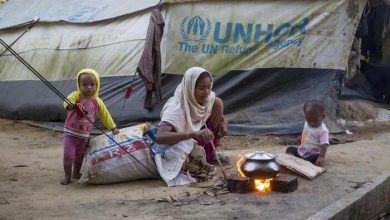
    Rohingya refugees cook outside their tent in Kutupalong refugee settlement.© UNHCR/Roger Arnold
    Rohingya refugees cook outside their tent in Kutupalong refugee settlement. © UNHCR/Roger Arnold

    ‘What future do we have here?’

    Rohingya community leader Mohammad Jashim said he was keen to return to Myanmar but wanted his citizenship rights guaranteed.

    “We are the citizens of Myanmar by birth. We want to go back home with all our rights, including citizenship, free movement, livelihood, safety, and security,” he told Reuters news agency, saying the refugees hoped for the UN’s help in this regard.

    Myanmar’s military had until recently shown little inclination to take back any Rohingya, who have for years been regarded as foreign interlopers in Myanmar and denied citizenship and subjected to abuse.

    Attempts to begin repatriation in 2018 and 2019 failed as the refugees, fearing prosecution, refused to go back.

    A group of 20 Rohingya told Reuters they would not return to Myanmar to “be confined in camps” after visiting their homeland as part of a pilot scheme aimed at encouraging voluntary repatriation.

    A Bangladesh official said the pilot scheme envisaged about 1,100 refugees returning to Myanmar, but no date had been set.

    Densely populated Bangladesh says refugees’ repatriation to Myanmar is the only solution to the crisis.

    Tom Andrews, UN special rapporteur on the human rights situation in Myanmar, on Thursday said Bangladesh must immediately suspend the pilot repatriation project for Rohingya to return to Myanmar, where they face serious risks to their lives.

    Meanwhile, surging crime, harsh living conditions and bleak prospects for returning to Myanmar are driving more Rohingya to leave Bangladesh by boat for countries such as Malaysia and Indonesia, putting their lives at risk.

    UN data shows 348 Rohingya are thought to have died at sea last year.

    Local communities in Bangladesh have also been increasingly hostile towards the Rohingya as international aid agencies’ funding for the refugees has dwindled.

    “Our situation is only deteriorating. What future do we have here?” asked refugee Mohammed Taher, as he stood with other protesters.

    SOURCE: NEWS AGENCIES